Kaspar Hauser’s Bread

Kaspar Hauser

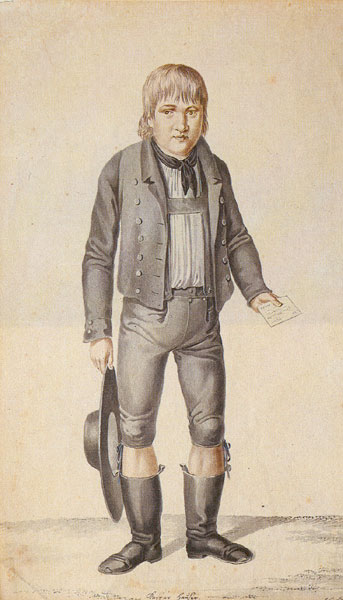
On the morning of May 26, 1828 a young boy, not more than sixteen, wandered into the busy town of Nuremberg, Germany. He was wearing a pair of ill-fitting boots, and he carried a small wooden horse with wheels. He could barely talk.

His name was Kaspar Hauser, and his appearance in Nuremberg that spring morning remains a mystery. Some guess that he was the lost prince of Baden, others that he was an impostor seeking attention. Kaspar was able to share only a scant few details about his previous life; it seems he grew up in a darkened cell, never glimpsing the light of day or breathing fresh air. The only human he had contact with was a mysterious man who brought him bread and water–the only food he ate during his captivity.

Despite his strangely sad past, Kaspar amazed the citizens of Nuremberg with his astute memory and fervent curiosity. His temperament was sweet, though he was said to be given to telling lies, and he quickly took to the daily drawing and music lessons given by his caretaker. But on the morning of December 14, 1833 he was fatally stabbed by an unknown assailant and died a few days later. A monument was erected in his honor, on which was written, “Here a mysterious one was killed in a mysterious manner.”

In honor of Kaspar’s austere diet, the Kitchen presents a recipe for a sourdough bread much like the German breads baked during Kaspar Hauser’s time. Serve it with sweet butter and cheese, or, if you wish to be more like Kaspar, eat it plain, with only a cup of water to wash it down.

Kaspar Hauser’s Bread

1 1/2 cups water
3 cups wheat flour
1 cup rye flour
1/2 cup wheat bran
1 tablespoon sea salt
1/2 cup flax seeds
2 tablespoons wheat gluten
1/2 cup sourdough starter

Mix all the ingredients together in a bowl until dough is smooth and firm. Place dough in fridge overnight. Take out the next day, shape and place in a cast iron pot. Let rise three to five hours, or until doubled in size. Put in a cold oven and turn heat to 425 degrees F. Bake for 40 minutes. After 40 minutes, remove lid and bake for another 20 minutes or until the crust is a deep brown.


Baumgarthuber, Christine. Fermented Foods: The History and Science of a Microbiological Wonder. Reaktion Books, 2021.

Would you rather receive The Austerity Kitchen by email? Then sign up for my Substack.

And, if you’d like to help the Kitchen keep cookin’, please consider picking up a copy of my book, which you may find on one of the sites listed here.

Wartime Beef and Bean Stew

U.S. wartime propaganda poster on food waste

Here’s another recipe from Mary Swartz Rose‘s Everyday Foods in War Time (1918) for a beef and bean stew. In her book, Swartz acknowledges that beef is not the most fitting repast for a time marked by dour wartime austerity and reminds the reader that it does represent an unnecessary expense and should be seen as somewhat of a luxury. “A pound of beef,” she writes, “will require the consumption by the animal of some fourteen pounds of grain.” This pound of beef will furnish “perhaps 1,200 calories, while the grain consumed will represent over 20,000 calories.” Foods like milk and grains are far more economical, Swartz writes, and do not strain the digestion as much as meat.

But there are economical meat dishes, Swartz continues, and they tend to feature meat as a flavoring rather than the entire substance of the meal. Swartz shares her delightful recipe for beef and bean stew, which uses beans as a tasty meat extender, as an example of such a dish. The recipe is copied below. Serve Swartz’s stew with a hearty peasant bread and a green salad.

Beef and Bean Stew

Beef, lower round, 1 pound
Red kidney beans, 1 cup
Onion, 1
Canned tomatoes, 1 cup, or 2 to 3 fresh tomatoes
Salt pork, 2 ounces

Wash the beans and soak them over night. Cut the pork into small pieces and try out the fat. Cut the beefs into small pieces and brown it in the pork fat, then add the vegetables with water enough to cover. Cook just below the boiling point for about three hours.


Why Fast and Fermented Foods by Christine Baumgarthuber

Would you rather receive The Austerity Kitchen by email? Then sign up for my Substack.

And, if you’d like to help the Kitchen keep cookin’, please consider picking up copies of my books, Why Fast? and Fermented Foods.

From the White House: Laplands

James K. Polk 45th president of the United States

James Knox Polk, Democrat and eleventh president of the United States (1845-1849), served as governor of Tennessee before ascending to the nation’s highest office. A dynamic leader, he oversaw the successful Mexican-American War. Despite the wave of popularity he enjoyed as a result of this war’s successful prosecution, he refused to seek a second term, and shortly after completing his first and only term he died of cholera.

Polk was born in a simple log cabin in Mecklenburg County. His father was a farmer frugal in his habits, but of a disposition kind and generous. As the oldest of ten children, Polk had to assume a great deal of responsibility for his siblings. Yet he managed to find time for his studies. When his family moved to the banks of the Cumberland River in Tennessee, Polk came under the tutelage of Rev. Dr. Henderson at the Academy of Murfreesburg, and in the autumn of 1815 he entered the University of North Carolina, from which he graduated in 1818 with highest honors.

A dignified austerity marked Polk’s term in office. Intent on eliminating the custom of dueling, which, recall, sped Alexander Hamilton to his long home, Polk quickly secured the passage of a law banning this barbaric remnant of the past, as he considered it. His wife, Sarah Childress Polk, helped him in these endeavors. She was a strict Presbyterian, plain of looks but charmingly intelligent, who quickly changed the image of the President’s home, initiating bans on drinking, dancing, card playing and fancy dining.

Here’s The Heritage Cook Book‘s traditional recipe for laplands, small muffin-like biscuits that were popular at the First Family’s austere table. Serve them with butter and jam.

Laplands

2 egg yolks
2/3 cup all-purpose flour
2/3 cup milk
1 tablespoon sugar
1 tablespoon butter, melted
2 stiffly beaten egg whites

Beat egg yolks till thick and lemon-colored, 4 to 5 minutes. Blend in flour, milk, sugar, butter, and 1/4 teaspoon salt. Beat 2 to 3 minutes. Gently fold in egg whites. Fill well-greased 2-inch muffin pans 2/3 full. Bake at 375 degrees F. for 30 to 35 minutes. Makes 10.


Why Fast and Fermented Foods by Christine Baumgarthuber

Would you rather receive The Austerity Kitchen by email? Then sign up for my Substack.

And, if you’d like to help the Kitchen keep cookin’, please consider picking up copies of my books, Why Fast? and Fermented Foods.