Barley Nut Bread: Feeding the Crowds at Columbia University and Elsewhere

pro-war rally in new york

In her 1918 cookbook One Hundred-Portion War Time Recipes, Bertha E. Nettleton, former manager of Columbia University’s Horace Mann Lunch Room, shares tips for feeding a crowd. “In the effort to plan menus which comply with suggestions and requirements of the Food Administration and which at the same time meet financial ends, the resources of the Institutional Manager or Lunch Room Director are taxed to the utmost,” she writes.

A nation at war taxes these resources all the more. Nettleton thus published her cookbook with “[t]he aim and purpose [of furnishing] recipes and suggestions helpful to those who are trying to cope with the present situation by increasing the variety of dishes which are palatable, nutritious, economical and practicable.” American doughboys could ship for Europe well-nourished, while noncombatants back home could do their part for the cause.

Continue reading
The French Voyeur’s Broiled Mackerel


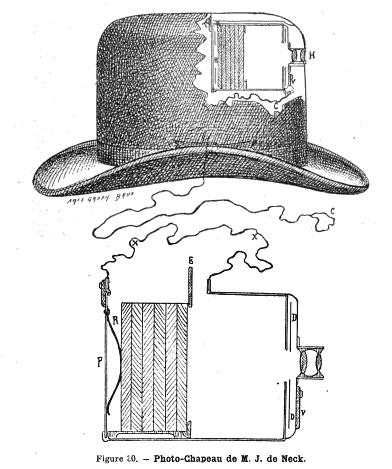
spy camera concealed in a hat

The narrator of Henri Barbusse’s 1908 novel The Inferno (L’Enfer) spends his days and nights peering through a chink in his boarding room wall, which he discovered shortly after taking possession of the room. He cannot help himself, he says, for as a man unmarried, rather short, with no children (and, he adds, who “shall have none”), as a man with whom “a line will end which has lasted since the beginning of humanity,” he felt himself “submerged in the positive nothingness of every day.”

He beguiles this positive nothingness by watching lovers couple, couples quarrel and old men die in the next room. He overhears confessions that make him question the existence of God. Slowly his knowledge of other lives becomes a burden. “I saw now how I should be punished for having entered into the living secrets of man.,” he reports. “I was destined to undergo the infinite misery I read in others…. Infinity is not what we think. We associate it with heroes of legend and romance, and we invest fiery, exceptional characters, like a Hamlet, with infinity as with a theatrical costume. But infinity reside quietly in that man who is just passing by on the street…. So, step by step, I followed the track of the infinite.”

Continue reading

Counterfeit Oysters from Paris

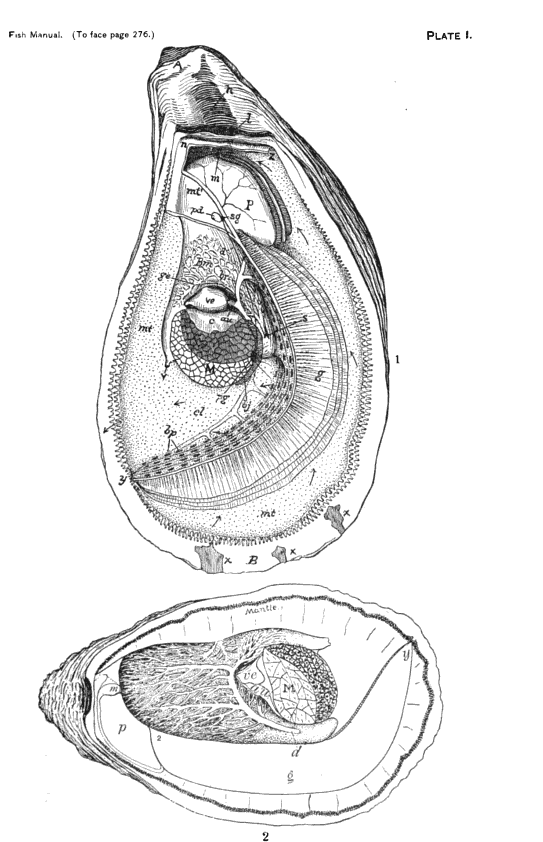
oyster anatomy, schematic illustration

Food adulteration presented a difficult problem in the nineteenth century. Unscrupulous types mixed plaster in flour, tinted butter yellow with marigolds and added arsenic to jarred pickles. An 1896 edition of the American Druggist and Pharmaceutical Reports shares an instance of food adultery taken to new heights. “One might imagine that shell fish would be about the last edible to attract the adulterer’s attention,” the article reports, “yet we are credibly informed that a Frenchman is now manufacturing artificial oysters which are so natural, both in appearance and taste, that, unless they are subjected to a chemical test they cannot be distinguished from genuine ones.”

How exactly are these faux oysters made? The American Druggist goes on to explain that the Frenchman uses “natural shells” which he fills with “certain substances” (what these are the article leaves unstated). The ersatz oysters were then “fastened together with isinglass and immersed in a liquor that speedily covers them with a thin silicate deposit.” The article ends by informing readers that the sham oysters “are being sold freely in Paris, at a price greatly below that which is charged for Blue Points.”

Continue reading