Traveling Beef Steak

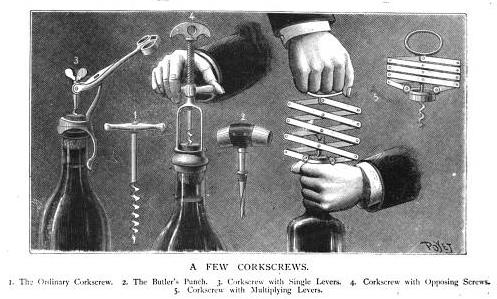
demonstration of various corkscrews

“All kitchens are alike, inasmuch as the various articles used for cooking purposes strongly resemble each other,” an 1851 article from Bizarre observes, “yet there is a marked difference in the quality of such instruments.” Indeed, some kitchen utensils seem altogether more useful than others. And though an anonymous reader of an 1896 edition of The American Kitchen Magazine warns readers about the dangers of “labor-saving machines” in the kitchen, earlier cooks welcomed ingenuity in the field of culinary arts.

Take for instance a particular invention of Sir Samuel Morland, who was known for his inquisitive mind, and who distinguished himself chiefly by his many mechanical inventions: the speaking trumpet, the fire engine, the steam engine, and the capstan for heaving anchors.

Continue reading

Tuesday Dinner at Maryland Insane Hospital

Maryland Sanitarium

The inmates of the Maryland Insane Hospital, we’re told, were exceedingly well-housed, well -clothed and well-fed. The hospital’s menu was lauded as an example of dietary excellence. According to a 1918 issue of Dietotherapy, inmates enjoyed such gustatory delights as beef tea, lemonade and, when cost did not prohibit it, fish on Fridays.

Such wholesome comestibles were rare in a time that saw egregious abuse of the mentally ill. But Maryland Insane Hospital was one of the most modern institutions of its kind. Now known as the Spring Grove Hospital Center, the hospital was established chiefly as a result of the lifelong individual efforts of Richard Spring Steuart, a Maryland physician and early pioneer in the treatment of mental illness. From its inception the asylum was the very picture of the well-managed institution. In 1884 the chairman of Maryland’s Joint Committee on Public Institutions found the asylum “in excellent condition,” a state which, he wrote, “reflects great credit upon its officers.”

Continue reading

India Cake

vintage ad for Burnett's almond extract

A 1916 advertisement for Burnett’s Almond Extract features a delightful, and economical, recipe for India Cake. Why economical? Because Burnett’s claims its economy comes from “its purity and strength,” which are effects of the fact that “one 2 oz. bottle of Burnett’s Almond gives more flavor than 5 ordinary 10c bottles of inferior or imitation extracts.”

The Joseph Burnett Company was incorporated in 1895 and quickly came to dominate the market in high-quality extracts. The company’s manufacturing headquarters was located in South Boston, and the beautifully restored factory that churned out extracts for worldwide distribution can still be seen today.

Though Joseph Burnett’s superior almond extract did not survive much beyond the mid-twentieth century, you can still make his famous cake by following the recipe below. Just make sure to use an almond extract just as pure and strong!

India Cake

Cream 3/4 cup butter and 2 cups sugar. Add 3 eggs, whites and yolks beaten separately and then together. Add 2 cups flour, 1 teaspoonful soda and 2 of cream of tartar. Add 1 cup milk and 1 scant teaspoonful of Burnett’s Almond. Bake in a slow oven, and frost.


Why Fast and Fermented Foods by Christine Baumgarthuber

Would you rather receive The Austerity Kitchen by email? Then sign up for my Substack.

And, if you’d like to help the Kitchen keep cookin’, please consider picking up copies of my books, Why Fast? and Fermented Foods.