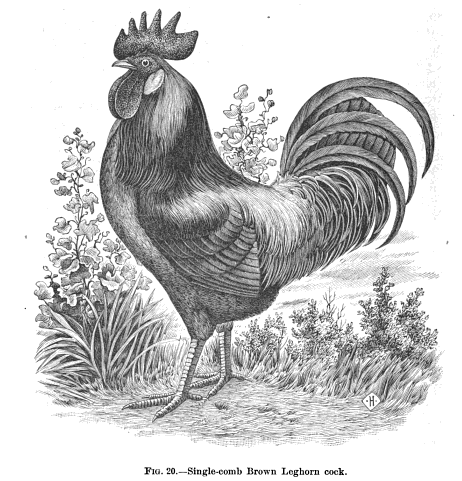
The Commonsensical Delights of Fried Chicken

leghorn cock

“What are we coming to? Whither are we drifting? And oh, times and oh, manners!”, writes Frank Crane in his 1920 collection of observations and ruminations, Adventures in Common Sense.

What — or who — occasions Crane’s lament? None other than the “chief high worshipful of the United States Food Research Department, Mary E. Pennington,” who in her research findings “deposes that FRIED CHICKEN is bad for us. That is to say, fried chicken that is fresh killed.”

The chief high worshipful decrees that all chicken “should be ripened from three to ten days in a temperature of 32 degrees.” Only then is the fowl fit to eat.

Crane considers this insanity. He writes that he “cannot get over the conviction that these scientific people are set upon robbing us of our most delectable things to eat. Naturally we would not strike a woman, but why does the Pennington lady attack us at the very core and citadel of our national gustatory treasure?”

Continue reading
Barley Nut Bread: Feeding the Crowds at Columbia University and Elsewhere

pro-war rally in new york

In her 1918 cookbook One Hundred-Portion War Time Recipes, Bertha E. Nettleton, former manager of Columbia University’s Horace Mann Lunch Room, shares tips for feeding a crowd. “In the effort to plan menus which comply with suggestions and requirements of the Food Administration and which at the same time meet financial ends, the resources of the Institutional Manager or Lunch Room Director are taxed to the utmost,” she writes.

A nation at war taxes these resources all the more. Nettleton thus published her cookbook with “[t]he aim and purpose [of furnishing] recipes and suggestions helpful to those who are trying to cope with the present situation by increasing the variety of dishes which are palatable, nutritious, economical and practicable.” American doughboys could ship for Europe well-nourished, while noncombatants back home could do their part for the cause.

Continue reading

The French Voyeur’s Broiled Mackerel


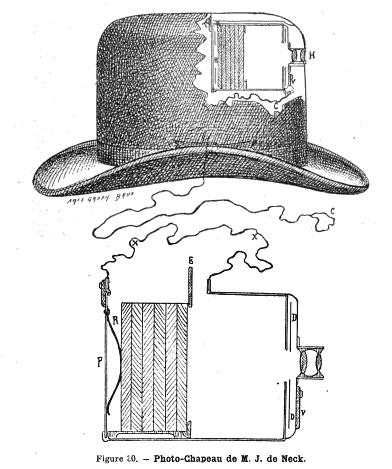
spy camera concealed in a hat

The narrator of Henri Barbusse’s 1908 novel The Inferno (L’Enfer) spends his days and nights peering through a chink in his boarding room wall, which he discovered shortly after taking possession of the room. He cannot help himself, he says, for as a man unmarried, rather short, with no children (and, he adds, who “shall have none”), as a man with whom “a line will end which has lasted since the beginning of humanity,” he felt himself “submerged in the positive nothingness of every day.”

He beguiles this positive nothingness by watching lovers couple, couples quarrel and old men die in the next room. He overhears confessions that make him question the existence of God. Slowly his knowledge of other lives becomes a burden. “I saw now how I should be punished for having entered into the living secrets of man.,” he reports. “I was destined to undergo the infinite misery I read in others…. Infinity is not what we think. We associate it with heroes of legend and romance, and we invest fiery, exceptional characters, like a Hamlet, with infinity as with a theatrical costume. But infinity reside quietly in that man who is just passing by on the street…. So, step by step, I followed the track of the infinite.”

Continue reading