From the White House: Laplands

James K. Polk 45th president of the United States

James Knox Polk, Democrat and eleventh president of the United States (1845-1849), served as governor of Tennessee before ascending to the nation’s highest office. A dynamic leader, he oversaw the successful Mexican-American War. Despite the wave of popularity he enjoyed as a result of this war’s successful prosecution, he refused to seek a second term, and shortly after completing his first and only term he died of cholera.

Polk was born in a simple log cabin in Mecklenburg County. His father was a farmer frugal in his habits, but of a disposition kind and generous. As the oldest of ten children, Polk had to assume a great deal of responsibility for his siblings. Yet he managed to find time for his studies. When his family moved to the banks of the Cumberland River in Tennessee, Polk came under the tutelage of Rev. Dr. Henderson at the Academy of Murfreesburg, and in the autumn of 1815 he entered the University of North Carolina, from which he graduated in 1818 with highest honors.

A dignified austerity marked Polk’s term in office. Intent on eliminating the custom of dueling, which, recall, sped Alexander Hamilton to his long home, Polk quickly secured the passage of a law banning this barbaric remnant of the past, as he considered it. His wife, Sarah Childress Polk, helped him in these endeavors. She was a strict Presbyterian, plain of looks but charmingly intelligent, who quickly changed the image of the President’s home, initiating bans on drinking, dancing, card playing and fancy dining.

Here’s The Heritage Cook Book‘s traditional recipe for laplands, small muffin-like biscuits that were popular at the First Family’s austere table. Serve them with butter and jam.

Laplands

2 egg yolks
2/3 cup all-purpose flour
2/3 cup milk
1 tablespoon sugar
1 tablespoon butter, melted
2 stiffly beaten egg whites

Beat egg yolks till thick and lemon-colored, 4 to 5 minutes. Blend in flour, milk, sugar, butter, and 1/4 teaspoon salt. Beat 2 to 3 minutes. Gently fold in egg whites. Fill well-greased 2-inch muffin pans 2/3 full. Bake at 375 degrees F. for 30 to 35 minutes. Makes 10.


Why Fast and Fermented Foods by Christine Baumgarthuber

Would you rather receive The Austerity Kitchen by email? Then sign up for my Substack.

And, if you’d like to help the Kitchen keep cookin’, please consider picking up copies of my books, Why Fast? and Fermented Foods.
A Film: Rationing in Britain, 1939

Here’s another charming and informative film from wartime Britain; it offers helpful hints about navigating the sometimes perplexing system of rationing and provides novel ideas for making the most of household odds and ends.

More Wartime Cooking: Wheatless Fruit Tarts

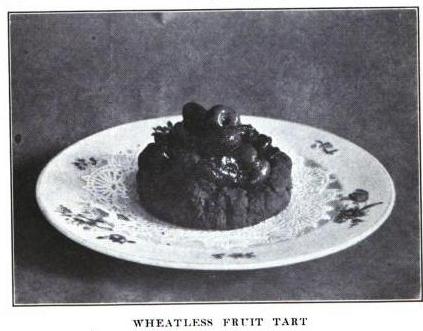
wheatless fruit tart – wartime cooking

Mary Elizabeth was convinced she could develop an entire repertoire of wartime wheatless and sugarless recipes. Her 1918 Mary Elizabeth’s War Time Recipes testifies to the success of her endeavor — the cookbook is filled with dozens of delightful recipes that eschew wheat, sugar and meat. “I am gathering these recipes,” she writes, “that they may help some folks who have the same earnest desire as myself to aid the Food Administration in every way but lack the facilities and time to work out their own recipes.”

Here’s a summer recipe from Mary Elizabeth’s cookbook for a wheatless fruit tart. It uses barley flour as a substitute for wheat, which results in a wonderfully flaky crust. Containing all eight amino acids, barley flour also packs a powerful nutritional punch.

Wheatless Fruit Tarts

1 1/2 cups barley flour
1/2 cup corn flour
1 teaspoon salt
1/2 cup hard vegetable shortening
4 tablespoons ice-cold water

Sift the two flours and salt together; cut into it the shortening, using a knife, until it is in tiny bits. Then rub together lightly with the hands until all the ingredients are well blended. Now add the water, mixing as little as possible.

Mold into a ball. Place on a well-floured bread-board. Roll thin, using a little flour on the rolling pin. Cut with a large biscuit-cutter and place over bottoms of muffin tins. Bake in a hot oven until light brown. When cold, fill the shells with fruit filling.

Fruit Filling for Tarts

Use rhubarb, strawberries, cherries, raspberries or currants. Canned fruit may be used in winter, but as they are sweetened, reduce the sugar quantity by one half.

1 quart fruit (any of the above varieties)
1 cup maple sugar (crushed)
1/4 cup water
3 level tablespoons corn starch

Boil until the fruit is tender. Then add three level tablespoons of cornstarch, dissolved in a tablespoon of water. Boil slowly, stirring constantly, for able five minutes longer. When cold, fill the tart molds and serve.


Why Fast and Fermented Foods by Christine Baumgarthuber

Would you rather receive The Austerity Kitchen by email? Then sign up for my Substack.

And, if you’d like to help the Kitchen keep cookin’, please consider picking up copies of my books, Why Fast? and Fermented Foods.