The Gooseberry: A Cottager’s Treat

Green and round with delicate translucent skin, the tart berries of the gooseberry bush first appear in June.

The plant grows in copses and hedgerows in areas of northern and central Europe; its origins are unknown, however. Pliny mentions it briefly. The plant was valued in the Middle Ages for its cooling properties in the treatment of fevers. But it wasn’t widely cultivated until the sixteenth century, when skilled gardeners in Holland deliberately propagated the gooseberry for eating.
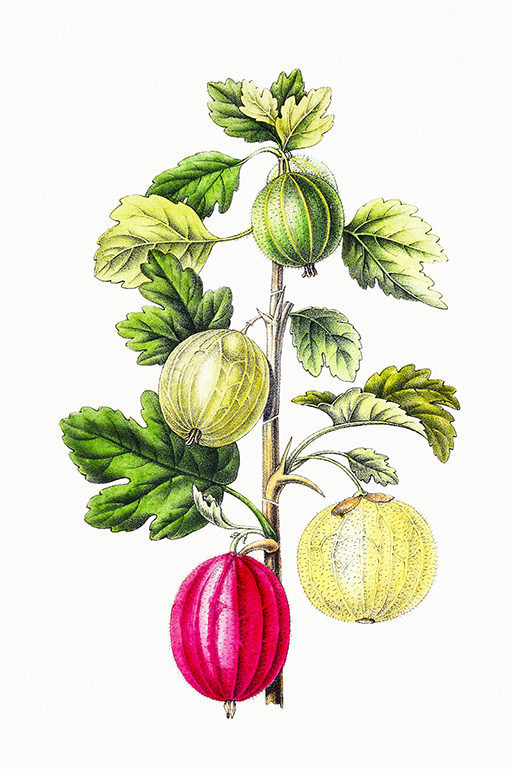
European Gooseberry Ribes Grossularia
Image: Biodiversity Heritage Library, CC BY 2.0, via Flickr

The gooseberry was a great favorite among the poor cottagers of Lancashire. They cultivated numerous varieties of gooseberry from seed in their small garden plots. An 1864 article from the Journal of Horticulture, Cottage Gardener and Country Gentlemen attributes the success of the gooseberry’s “fruit culture” to the “humbler population” of the district who managed to increase the size of their gooseberries. The Journal urges its readers to imitate “the good works of these real cottage gardeners.”

Today there are over two thousand varieties of gooseberry, with berries in all shades of color. Pink, white and yellow gooseberries are just a few of the color variations developed over the past centuries.

Gooseberries are eaten in pies, relishes, puddings and even omelets. Here’s a nineteenth-century recipe for gooseberry preserves, much like the one enjoyed in those humble Lancashire cottages.

Gooseberry Preserves

For every quart of gooseberries, add one pound of granulated sugar, dissolving it in the preserving kettle [a heavy-bottomed saucepan] with as much water as it will take to make a syrup. Let it boil for twenty minutes, skimming well; then put in the gooseberries, and boil five minutes; then set by till the next day, then boil again until they [the gooseberries] have a clear look and the syrup is thick. Put up in jelly glasses, with brandied paper on top.


Why Fast and Fermented Foods by Christine Baumgarthuber

Would you rather receive The Austerity Kitchen by email? Then sign up for my Substack.

And, if you’d like to help the Kitchen keep cookin’, please consider picking up copies of my books, Why Fast? and Fermented Foods.

From Austerity Britain: Stuffed Cabbage

Stuffed Cabbage Great Britain World War 2

During the Second World War, the British Ministry of Food dealt with food shortages by instituting a system of rationing. Each citizen was given a ration booklet, which they had to present to their local shopkeeper. In exchange for money and ration tickets, the customer would receive a set amount of food.

In Britain, as in Germany, rationing was introduced early in the war. By late January 1940 many of the more common foodstuffs required ration tickets. Bacon, butter, marmalade and eggs were just a few of the items rationed by the Ministry of Food.

But the Ministry of Food didn’t leave the citizenry unaided when it came to figuring out how to prepare the sometimes unappetizing rations. Using various media outlets to popularize recipes for making the most of one’s meager allotment, the Ministry of Food helped the British housewife become accustomed to wartime austerity. Its recipes appeared in newspapers, radio broadcasts and postings in public buildings.

Here’s a recipe for stuffed cabbage from the March 29, 1941 edition of The Times of London. The cabbage and root vegetables help extend the meat, which was one of the foods rationed during the war.

Wartime Stuffed Cabbage

1 large cabbage
1 pound cooked meat, minced
4 ounces breadcrumbs
2 or 3 carrots
1 small turnip
1 parsnip
Salt and pepper to taste

Grate the raw vegetables and mix them together with the meat and breadcrumbs. Season with salt and pepper. Wash the cabbage and dry carefully before stuffing the mixed mince between the leaves. To make sure the leaves do not open, tie a string around the cabbage and then put it into a saucepan with a little boiling water. Put on the lid and cook steadily until tender. Save the water for soup or gravy.


Why Fast and Fermented Foods by Christine Baumgarthuber

Would you rather receive The Austerity Kitchen by email? Then sign up for my Substack.

And, if you’d like to help the Kitchen keep cookin’, please consider picking up copies of my books, Why Fast? and Fermented Foods.

From the Omalos Plateau: Cretan Rusk Salad

Cretans in native costume

The high and rugged mountains of Crete span its entire length, forming three different ranges. One of these ranges, known as Lefka Ori, is famous for the plateau of Omalos, a circular plain surrounded by green, rounded mountains. For centuries the Omalos plateau was a strategic base for Cretan revolutionaries fighting invading armies.

But the Omalos plateau was also the site of more peaceful activities.

With its remarkably fertile soil, which in the springtime is blanketed in grasses and wild herbs, the Omalos plateau was a favorite place for stockbreeding. Stockbreeders would drive herds of goats and sheep to Omalos’s verdant plains to feast on dittany and oregano, setting up camp for months at a time on the vast, empty stretches. There they lived lonely lives, with only a small camp fire and a few songs remembered from home to keep them company through the long nights on the plateau.

For provisions, the stockbreeders brought rusks–baked by their wives specially for the journey–that they ate with aromatic soups and salads of wild herbs and snails. The rusks were made of roughly milled barley. Their coarse, dry texture guaranteed they would survive the journey into the mountains intact and, once there, stay fresh for months.

Here’s a recipe for a salad of Cretan rusks and fresh vegetables, a traditional dish enjoyed in Crete. Should Cretan rusks not be available your area, substitute day-old bread.

Cretan Rusk Salad

3 tomatoes
3 green peppers
1/2 large red onion
3 cucumbers, peeled
1/2 cup whole Greek olives
3/4 cup olive oil
2 tbsp red wine vinegar
2 tbsp lemon juice
3 Cretan rusks
salt and pepper
fresh oregano (can use dried)

Cut the tomatoes, peppers, onion and cucumbers into slices. Place in a large salad bowl. Mix olive oil, red wine vinegar and lemon juice. Break up Cretan rusks into small pieces. Sprinkle over salad with the olives. Pour dressing over salad and then season with oregano, salt and pepper.


Why Fast and Fermented Foods by Christine Baumgarthuber

Would you rather receive The Austerity Kitchen by email? Then sign up for my Substack.

And, if you’d like to help the Kitchen keep cookin’, please consider picking up copies of my books, Why Fast? and Fermented Foods.