Mushrooms: The Poor Man’s Meat

Fly agaric mushroom

Alfred Kreymborg felt the lowly mushroom perfectly exemplified his poetic genius. In his 1916 Mushrooms: A Book of Free Forms he wrote, “Mushrooms spring up overnight in my heart […] myriads and myriads I have found down there, but only a handful have I plucked so far.”

Perhaps Kreymborg should have plucked more of his heart’s lyrical fungi: His book garnered mixed reviews. But its subject continues to fascinate. Coming in all shapes and sizes, mushrooms begin to peek from the loamy soil once the weather turns cool and moist. The tall, proud Panther Cap juts from piles of decaying leaves, and Giant Puffballs swell their waxen bellies under the forest floor. Shaggy Coprinus grows a cap of yellowed scales beneath which peek the frill of purple gills; deadly Amanita glares from hollowed trees.

Prized for their tasty flesh mushrooms were a favorite food among the rural poor, who looked to the forests for a free supply. In the nineteenth century reformers urged English cottagers to start growing mushroom crops systematically to supplement their meager diets. In 1884 John Wright, assistant editor of the Journal of Horticulture and Home Farmer, called the mushroom “the most profitable outdoor crop known.” He urged all cottagers to undertake mushroom farming as “a well-conducted method of growing Mushrooms will pay better” than all other food crops.

In France pallid workers grew mushrooms in caves and abandoned mines. The Seine region alone had almost 3,000 mushroom caves, in which about 300 people worked and lived, rarely seeing the light of day. These subterranean farmers carefully tended beds of seeded manure until their delicate crop peeped forth. Then at exactly one in the morning, when the air was sufficiently clammy and chill, they harvested the mushrooms and, no more than two hours later, rushed them off to the bustling markets of France.

boletus satanas devil's bolete
The Devil’s Bolete

Here is a recipe for fried mushrooms, a dish that was popular among the peasantry throughout Europe. If you can, try to use the ample Steinpilz, otherwise known as the King Bolete–it is an exceptionally tasty variety of mushroom. Look for its tell-tale “hump” under piles of fir needles in coniferous forests.

Serve this dish with pasta or as substitute for meat in a sandwich.

Fried Mushrooms

Peel large, firm mushrooms, taking care not to break them, and cut off the stalks. Roll mushrooms in cracker meal [or breadcrumbs], dip them in beaten egg, then in cracker meal again. Sprinkle with salt and pepper and fry in butter. Garnish with slices of lemon.


Baumgarthuber, Christine. Fermented Foods: The History and Science of a Microbiological Wonder. Reaktion Books, 2021.

Would you rather receive The Austerity Kitchen by email? Then sign up for my Substack.

And, if you’d like to help the Kitchen keep cookin’, please consider picking up a copy of my book, which you may find on one of the sites listed here.
Review: The Food of a Younger Land

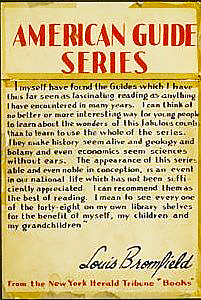
Page from the American Guide Series edited by Louis Bromfield
From the American Guide Series

The Food of a Younger Land: A Portrait of American Food Before the National Highway System, Before Chain Restaurants, and Before Frozen Food, When the Nation’s Food Was Seasonal
by Mark Kurlansky
Riverhead, 416 pp. ISBN 1594488657

“No American seems yet to have mastered the art of making a perfect guide book,” complained a reviewer in the June 4, 1893 edition of The New York Times. What made this deficiency apparent was the fact that the book under review, a recently published Baedeker guide to travel in the United States, was written by an Englishman. The guide’s “faithful and accurate description” of the country as seen by “unprejudiced foreign eyes,” were virtues that all “sensible Americans” could appreciate, the reviewer admitted, but they could not conceal the guide’s sketchy, terse quality. The reviewer took particular umbrage with an opening piece on American politics, which he considered “scarcely a substitute for a complete history of the United States.” And the text’s many Britishisms compounded this shortcoming; the reviewer spent many column-inches glossing them.

The desire to produce American-made American guidebooks led Works Progress Administration organizer Katherine Kellock to head a project that commissioned guidebooks for each of the then forty-eight states. In the 1930s she enlisted the help of state residents, many of whom had local ties stretching back generations. Colonial history and covered bridges became subjects lovingly rendered by an old New England family. Frontier fracases and the elusive Bigfoot sprang to life from the pen of renowned Idaho author Vardis Fisher.

As the American Guide Series neared completion, Kellock decided to begin a new project. Called America Eats, this endeavor, organized much like the American Guide Series, set out to document the eating traditions of various regions in the United States. America Eats enlisted the help of 6,686 correspondents who were asked to document the culinary idiosyncrasies of their home states.

From America Eats: Los Angeles Sheriff’s Barbecue, ca. 1930-1941


Unfortunately, the outbreak of the Second World War stopped the project. The partial result was, however, complete enough eventually to serve as the subject of Mark Kurlansky’s The Food of a Younger Land: A Portrait of American Food Before the National Highway System, Before Chain Restaurants, and Before Frozen Food, When the Nation’s Food Was Seasonal, which contains “not always the best but the most interesting” pieces from America Eats, Kurlansky writes.

When he first opened the files of America Eats, Kurlansky “felt as though [he] had accidentally stumbled back into prewar America.” It is indeed difficult not to experience a dizzying nostalgia upon reading the selections from America Eats. Many are nothing short of entrancing: A New Mexico correspondent writes about la merienda, a mid-afternoon meal of fried beans and smoked kid which sun-weary field hands enjoy in the cool bank of an arroyo. From Pennsylvania we learn of the moist and odorous workings of a mushroom farm. A correspondent from California waxes poetic over the annual grunion fry, where the slippery quicksilver bodies of a million mating fish are scooped from the beach and tossed into boiling vats of oil.

From America Eats: Boiling chicken and rice in iron kettles, ca. 1930-1941


Despite these and many more similar vignettes, one finishes the book with an insatiable desire for even more glimpses of an America that has long been swept into history’s dustbin. In this respect, The Food of a Younger Land represents more a delectable array of hors d’oeuvres than a sumptuous banquet. This may, however, reflect more the reader’s condition than the book’s quality. For Kurlansky reminds us that we have betrayed the traditions described by the correspondents of America Eats. “It is terrifying,” he observes, “to see how much we have lost in seventy years.” Starved of such tradition, the reader can only hungrily wish for more than the already ample bounty of Kurlansky’s book.

Reader’s appetite aside, The Food of a Younger Land offers an important lesson: that the bonds of family and community are forged through simple communal pleasures. A neighborhood picnic where folks share stories and food does more to preserve the traditions of a community and strengthen its social fabric than an entire army of archivists.

Below is a recipe from The Food of a Younger Land for “Depression Cake.” In a delightful and engaging vignette, a correspondent describes the plight of a young woman named Ethel who, when faced with a cupboard bare of butter and milk on the Fourth of July, developed a recipe for a cake that used what few ingredients were available. She was, at first, trepidatious–the batter seemed “a volcanic mass in her mixing bowl.” But once out of the oven, the cake proved a success, smelling of “Old World spices” and baked a perfect brown.

Depression Cake

1 cup raisin juice, from stewed raisins
1 teaspoon baking soda
1/2 teaspoon cinnamon
1/2 teaspoon nutmeg
A pinch of cloves, ginger and allspice
1 tablespoon drippings (or other fat)
1 3/4 cups flour
1 cup sugar
1 teaspoon baking powder
1 teaspoon vanilla
A pinch salt

In a large bowl mix the raisin juice, baking soda, spices and drippings. In a separate bowl, mix flour, sugar, baking powder and salt together. Add to the raisin juice mixture. Mix together and then add vanilla. Place in a greased loaf pan and bake for an hour at 350 degrees F.


Why Fast and Fermented Foods by Christine Baumgarthuber

Would you rather receive The Austerity Kitchen by email? Then sign up for my Substack.

And, if you’d like to help the Kitchen keep cookin’, please consider picking up copies of my books, Why Fast? and Fermented Foods.

May-Day Bannocks

Spotted Cranesbill May Day Beltane
Spotted Cranesbill

On the first of May 1892, chimney sweeps, their faces blackened with soot, danced down the streets of Cheltenham, playing fiddles and tin-whistles. A large cluster of bright green leaves and twigs fastened to a wooden framework followed. This strange manmade bush, out of which peeked a smiling face, was followed in turn by a large group of laughing, drunken men, each of whom was crowned with a garland of small, bright flowers and dressed in loose-fitting bodices and trousers of flower-patterned calico.

One might wonder what kind of madness struck the town of Cheltenham on that warm spring day in 1892. But it was nothing more than the sweet joy of a May-Day celebration.

Associated with the Celtic feast of Beltane, May Day marks the end of winter in the northern hemisphere. The holiday was cause for raucous celebrations among the peasantry and lower classes, and wild dances of unbridled happiness, usually around a maypole festooned with flowers and wreaths, took place across Europe and the Americas.

Such was the mirth and celebration of May Day that some towns refused to take their maypole down at the holiday’s end: Deep within the Black Forest, in the village of Furtwangen, a maypole stood all the year round, sporting a placard on which was written, “Glück und Segen dem neuen Wirth” (a wish for happiness and peace). A long string of red poppies wound around the proudly defiant pole, and wine bottles and beer glasses were affixed to its cross-tree.

Francisco de Goya y Luciente, The Maypole (1816–18)

The meals served on May Day were simple affairs — thick slices of bread covered in butter and honey, creamy custards and jugs of beer. But before preparations for the May-Day feast could start, the leftovers of May-eve dinner had to be buried in the garden lest, according to British superstition, fairies and other evil sprites rendered them fatal with their magic on Walpurgisnacht.

Here’s recipe for Scottish bannocks, a traditional May-Day food, from Rampant Scotland. They were usually marked with a cross after baking as protection against evil spirits. Serve the bannocks with butter and honey — and if you serve them on the eve of May Day, don’t forget to bury them in your garden the next morning.

May-Day Bannocks

4 ounces (125 grams) oatmeal
2 teaspoons fat, melted (use bacon fat, if available)
2 pinches baking powder
Pinch of salt
3/4 teaspoon (or more) hot water
Additional oatmeal for kneading

Mix the oatmeal, salt and bicarbonate and pour in the melted fat into the centre of the mixture. Stir well, using a porridge stick if you have one and add enough water to make into a stiff paste. Cover a surface in oatmeal and turn the mixture onto this. Work quickly as the paste is difficult to work if it cools. Divide into two and roll one half into a ball and knead with hands covered in oatmeal to stop it sticking. Roll out to around quarter inch thick. Put a plate which is slightly smaller than the size of your pan over the flattened mixture and cut round to leave a circular oatcake. Cut into quarters (also called farls) and place in a heated pan which has been lightly greased. Cook for about 3 minutes until the edges curl slightly, turn, and cook the other side. Get ready with another oatcake while the first is being cooked.

An alternative method of cooking is to bake them in an oven at Gas5/375F/190C for about 30 minutes or until brown at the edges. The quantities above will be enough for two bannocks about the size of a dessert plate. If you want more, do them in batches rather than making larger quantities of mixture. Store in a tin and reheat in a moderate oven when required.


Why Fast and Fermented Foods by Christine Baumgarthuber

Would you rather receive The Austerity Kitchen by email? Then sign up for my Substack.

And, if you’d like to help the Kitchen keep cookin’, please consider picking up copies of my books, Why Fast? and Fermented Foods.