Wartime Beef and Bean Stew

U.S. wartime propaganda poster on food waste

Here’s another recipe from Mary Swartz Rose‘s Everyday Foods in War Time (1918) for a beef and bean stew. In her book, Swartz acknowledges that beef is not the most fitting repast for a time marked by dour wartime austerity and reminds the reader that it does represent an unnecessary expense and should be seen as somewhat of a luxury. “A pound of beef,” she writes, “will require the consumption by the animal of some fourteen pounds of grain.” This pound of beef will furnish “perhaps 1,200 calories, while the grain consumed will represent over 20,000 calories.” Foods like milk and grains are far more economical, Swartz writes, and do not strain the digestion as much as meat.

But there are economical meat dishes, Swartz continues, and they tend to feature meat as a flavoring rather than the entire substance of the meal. Swartz shares her delightful recipe for beef and bean stew, which uses beans as a tasty meat extender, as an example of such a dish. The recipe is copied below. Serve Swartz’s stew with a hearty peasant bread and a green salad.

Beef and Bean Stew

Beef, lower round, 1 pound
Red kidney beans, 1 cup
Onion, 1
Canned tomatoes, 1 cup, or 2 to 3 fresh tomatoes
Salt pork, 2 ounces

Wash the beans and soak them over night. Cut the pork into small pieces and try out the fat. Cut the beefs into small pieces and brown it in the pork fat, then add the vegetables with water enough to cover. Cook just below the boiling point for about three hours.


Why Fast and Fermented Foods by Christine Baumgarthuber

Would you rather receive The Austerity Kitchen by email? Then sign up for my Substack.

And, if you’d like to help the Kitchen keep cookin’, please consider picking up copies of my books, Why Fast? and Fermented Foods.
A Novel Delight: Bean Porridge

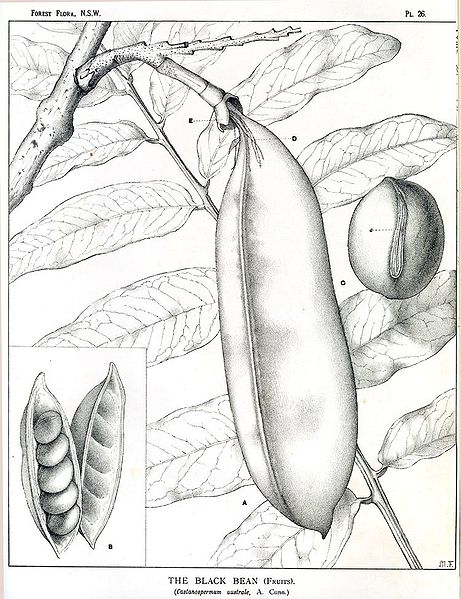
black bean (castanospermumaustrale)– illustration

“It is the fashion nowadays to descry this staple food of our grandmothers,” the author of an 1889 Good Housekeeping article confesses of the bean. “Beans are said to be coarse, indigestible,” she continues, “[and] only suitable for the laboring classes.” Yet she also admits that the humble bean possesses many virtues: “they are most nutritious, appetizing, healthful and economical, not only for stout men and boys, but for delicate women and children as well.” A pound of beans “contains nearly six ounces of heat-producing properties and half an ounce of flesh-forming food.”

The author ends her “dissertation on beans” by urging the reader to try a most unusual dish capable of producing a “novel sensation of delight”: bean porridge. Cheap and nourishing, bean porridge will have husbands and growing boys calling for it “again and again.” And how does one prepare this wonderful and economical dish? The recipe is copied below.

Bean Porridge

In the beginning, wash five pounds of corned beef, put it in a kettle of cold water, let it heat slowly and simmer gently all day. At night remove the pot from the stove, so that the fat may harden at the top and be removed. Whether you remove the beef at night or wait till morning is optional, since the beef’s mission to the porridge is ended with the day’s boiling. If, however, you leave it in over night and then press it carefully, it has rather a better flavor and makes a delicious cold relish for breakfast or lunch, all which you have in addition to your porridge,–another item to score in favor of its economy.

Also pick over and put to soak one and one-half cupful of beans. Next morning remove the cake of fat from the liquor in the pot, add to it the beans, well rinsed, and two cupfuls of yellow hominy from which the hulls have been washed. Set all on the back of the stove and let it barely simmer for hours and hours, watching it carefully and stirring often, so that it will not burn. If it boils hard it will not be fit to eat. It is best to keep it just below the boiling point, without the slightest ebullition possible. A little bicarbonate of potash [baking soda] added to the porridge will make it more digestible, but is not absolutely necessary. After it has cooked five or six hours you may, if you cannot possibly wait for your new sensation, try a little for lunch the very same day. [The stew should, before serving,] be rubbed through a colander. It will form a very rich, thick puree.


Why Fast and Fermented Foods by Christine Baumgarthuber

Would you rather receive The Austerity Kitchen by email? Then sign up for my Substack.

And, if you’d like to help the Kitchen keep cookin’, please consider picking up copies of my books, Why Fast? and Fermented Foods.
Johnny Cakes

Johnny Cake being chased by a bear

“Small, poor rations again today in the shape of corn bread and peas,” complained a settler of the Allamakee County, Iowa. Though the Allamakee settler looked upon his rations of cornbread and peas in disgust, bread made from cornmeal did play a important role in the diets of the early American settlers and was frequently cited as being quite tasty. The pioneers of the Ohio Valley used cornmeal as their common “bread-stuff,” grinding it with a pestle in a wooden mortar. This roughly ground cornmeal was often prepared as johnny-cakes–a term that is a corruption of “journey-cakes.” The cakes were mixed with rye and lard and baked before the fire on a “johnny” board about two feet long and eight inches wide. In Kentucky, they did things a bit differently: slaves would bake their cornmeal on a hoe and called the finished product hoe cakes.

In My Australian Girlhood, Sketches and Impressions of Bush Life (1902) Mrs. Campbell Praed describes the preparation of johnny cakes in the bush. “First, you must cut a small sheet of bark from a gum tree near,” she writes, “heap on it a mound of flour, in which you must hollow a hole and fill it with water, then work up the mass into a dry dough, which you must cut into thin cakes.” A large part of the art, according to Mrs. Praed, lies in preparing the fire: “For if the ashes be not properly prepared, the Johnny-cake will be heavy and no longer a Johnny-cake; it is then a ‘Leather-jacket,’ or it is a ‘Beggar on coals,’ when little bits of the sticks are turned into charcoal and make black marks on the dough.”

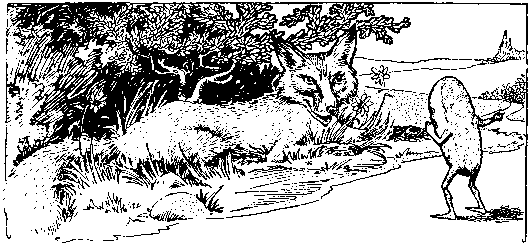
An 1890 illustration from the tale of little Johnny-CakeThe tale of little Johnny-Cake, illustration


Here’s an 1841 recipe for johnny cakes from The American Housewife. Serve them with butter and maple syrup, or alongside more savory dishes. Just be careful not to bake yourself the dreaded “Leather-jacket”!

Johnny Cakes

Scald a quart of sifted Indian meal [corn meal] with sufficient water to make it a very thick batter. Stir in two or three teaspoonfuls of salt — mould it with the hand into small cakes. In order to mould them up, it will be necessary to rub a good deal of flour on the hands, to prevent their sticking. Fry them in nearly fat enough to cover them. When brown on the underside, they should be turned. It takes about twenty minutes to cook them. When cooked, split and butter them. Another way of making them, which is nice, is to scald the Indian meal, and put in saleratus [baking soda], dissolved in milk and salt, in the proportion of a teaspoonful of each to a quart of meal. Add two or three tablespoons of wheat flour, and drop the batter by large spoonfuls into a frying pan. The batter should be of a very thick consistency, and there should be just fat enough in the frying pan to prevent the cakes sticking to it.


Why Fast and Fermented Foods by Christine Baumgarthuber

Would you rather receive The Austerity Kitchen by email? Then sign up for my Substack.

And, if you’d like to help the Kitchen keep cookin’, please consider picking up copies of my books, Why Fast? and Fermented Foods.