
Here’s a 1941 film from Britain’s Empire Tea Bureau on making the perfect cup of tea. A rare luxury, tea was carefully prepared by the wartime housewife — it was of the utmost importance that not a drop go to waste because of carelessness.
Kaspar Hauser’s Bread

On the morning of May 26, 1828 a young boy, not more than sixteen, wandered into the busy town of Nuremberg, Germany. He was wearing a pair of ill-fitting boots, and he carried a small wooden horse with wheels. He could barely talk.
His name was Kaspar Hauser, and his appearance in Nuremberg that spring morning remains a mystery. Some guess that he was the lost prince of Baden, others that he was an impostor seeking attention. Kaspar was able to share only a scant few details about his previous life; it seems he grew up in a darkened cell, never glimpsing the light of day or breathing fresh air. The only human he had contact with was a mysterious man who brought him bread and water–the only food he ate during his captivity.
Despite his strangely sad past, Kaspar amazed the citizens of Nuremberg with his astute memory and fervent curiosity. His temperament was sweet, though he was said to be given to telling lies, and he quickly took to the daily drawing and music lessons given by his caretaker. But on the morning of December 14, 1833 he was fatally stabbed by an unknown assailant and died a few days later. A monument was erected in his honor, on which was written, “Here a mysterious one was killed in a mysterious manner.”
In honor of Kaspar’s austere diet, the Kitchen presents a recipe for a sourdough bread much like the German breads baked during Kaspar Hauser’s time. Serve it with sweet butter and cheese, or, if you wish to be more like Kaspar, eat it plain, with only a cup of water to wash it down.
Kaspar Hauser’s Bread
1 1/2 cups water
3 cups wheat flour
1 cup rye flour
1/2 cup wheat bran
1 tablespoon sea salt
1/2 cup flax seeds
2 tablespoons wheat gluten
1/2 cup sourdough starter
Mix all the ingredients together in a bowl until dough is smooth and firm. Place dough in fridge overnight. Take out the next day, shape and place in a cast iron pot. Let rise three to five hours, or until doubled in size. Put in a cold oven and turn heat to 425 degrees F. Bake for 40 minutes. After 40 minutes, remove lid and bake for another 20 minutes or until the crust is a deep brown.

Would you rather receive The Austerity Kitchen by email? Then sign up for my Substack.
And, if you’d like to help the Kitchen keep cookin’, please consider picking up a copy of my book, which you may find on one of the sites listed here.
The Austerity Kitchen Challenge: Lazy Pierogi
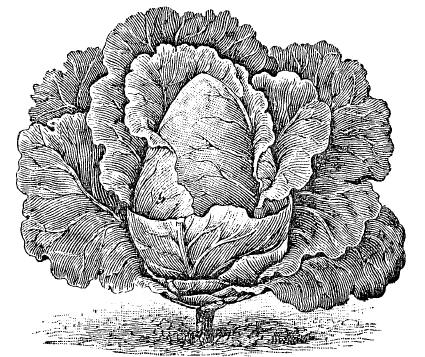
The cabbage didn’t appear with any frequency on the British table until the tumultuous reign of Henry VIII, when its cultivation started to be taken seriously by frugal-minded cottagers. Dozens of varieties were cultivated by these industrious cottagers, including the prodigious cow cabbage, which was said to reappear year after year without human interference, producing monstrous heads large enough to satisfy voracious bovine stomachs. A Norman variety more tasty to the human palate was frequently reported to reach heights of six or seven feet, and the hearty Strasburg cabbage weighed in at more than twenty-five pounds.
Needless to say, the cabbage was seen as an economical and tasty addition to the table–as well as an interesting and nutritious one. Belonging to the family Brassicaceae, the cabbage derives from the wild mustard plant and comes in a variety of colors — purple, green and red. It is an excellent source of vitamin C and contains the rare amino acid glutamine.

This month’s Austerity Kitchen Challenge presents a dish–lazy pierogi–that features cabbage in its fermented form — as sauerkraut, that is. Lazy pierogi is a delightful and inexpensive mix of mushrooms, onions, sauerkraut and pasta. Serve it with a green salad and a nice table wine.
Lazy Pierogi
1 package spiral pasta
4-5 tablespoons olive oil
2 onions
1 8-ounce package mushrooms
2 cups sauerkraut
pepper
garlic powder
smoked paprika (optional)
Boil the pasta until al dente. Drain and set aside. Chop and fry in the olive oil the onions and mushrooms. Add pepper, garlic powder and smoked paprika to taste. Add the sauerkraut and stir until thoroughly mixed in. Add pasta and toss together. Serve immediately.

Would you rather receive The Austerity Kitchen by email? Then sign up for my Substack.
And, if you’d like to help the Kitchen keep cookin’, please consider picking up copies of my books, Why Fast? and Fermented Foods.
 The Austerity Kitchen