From Medieval Bavaria: Wild Game and Peppersauce

medieval depiction of town life in Germany

The small Bavarian town of Abensberg sits on the banks of the Abens river, a tributary of the Danube. Flanked by thirty-two round and square turrets, the town was formerly the residence of the counts of Abensberg, whose castle still overshadows the town’s turreted walls.

This castle was the site of a peculiar scene. When Heinrich II, the fifth and last Holy Roman Emperor of the Ottonian dynasty, made his journey through Germany after his coronation in 1002, courtiers lavished him with offerings of gold and other treasures in order to demonstrate their fealty. When Heinrich stopped in Abensberg, he was presented with a gift of a different nature. For the Count of Abensberg brought forward thirty-two of his thirty-seven children and offered them body and soul to the new monarch. The count avowed that they were “the most valuable offering he could make to his king and country.”

How the count — or Heinrich, for that matter — managed to feed this brood of Bavarian princelings is left to historical imagination, but it is easy to picture a long table groaning with dishes of wild game prepared in a manner similar to this dish from Sabina Welserin, a sixteenth-century compiler one of the oldest German cookbooks.

Wild Game Marinated in Peppersauce

Boil fresh game in two parts water and one part wine, and when it is done, then cut it into pieces and lay it in a peppersauce. Let it simmer a while therein. Make [the sauce] so: Take rye bread, cut off the hard crust and cut the bread into pieces, as thick as a finger and as long as the loaf of bread is. Brown it over the fire, until it begins to blacken on both sides. Put it right away into cold water. Do not allow it to remain long therein. After that put it into a kettle, pour into it the broth in which the game was boiled, strain it through a cloth, finely chop onions and bacon, let it cook together, do not put too little in the peppersauce, season it well, let it simmer and put vinegar into it, then you have a good peppersauce.


Why Fast and Fermented Foods by Christine Baumgarthuber

Would you rather receive The Austerity Kitchen by email? Then sign up for my Substack.

And, if you’d like to help the Kitchen keep cookin’, please consider picking up copies of my books, Why Fast? and Fermented Foods.

Swedish Codfish

poultry and game


“We fly to Jemteland, where the rocky mountains are high and blue; where the Foss roars and rushes; where the torches are lighted as budstikke, to announce that the ferryman is expected. Up to the deep, cold, running waters, where the midsummer sun does not set; where the rosy hue of eve is that of morn.”

“That is the birds’ song,” writes Hans Christian Andersen in his 1871 travel memoir Pictures of Travel in Sweden, “Shall we lay it to heart? Shall we accompany them — at least a part of the way?” He did follow those birds, and his travels led him through the “glorious land” of Sweden, “home of the limpid elves, where the wild swans sing in the gleam of the Northern Lights.”

Andersen’s meanderings through the land of endless forests eventually brought him to Kinnakulla, Sweden’s hanging gardens. “The travellers go from the forest road up to the top of Kinnakulla,” he writes, “where a stone is raised as the goal of their wanderings.” From this vantage point, where black clouds of crows and ravens scream across a pale blue sky, Anderson writes that he can survey “Wener, to Lockö’s old palace, to the town of Lindkjöping.”

Perhaps Andersen visited an inn in the town of Lindkjöping–unfortunately he does not say if he did or not–and enjoyed a humble meal of stewed codfish, like this one from the 1897 Fullständigaste Svensk-Ameritansk kokbok: Swedish-English Cookbook.

Stewed Codfish

Pound the fish and soak 36 hours; take up, remove the bones and pick it to pieces, boil until tender. Melt in a pan a piece of butter together with a handful flour and add milk enough to make a somewhat thick sauce. Boil it and put the fish into it. Potatoes or cut carrots might be added. Season with pepper and salt.


Baumgarthuber, Christine. Fermented Foods: The History and Science of a Microbiological Wonder. Reaktion Books, 2021.

Would you rather receive The Austerity Kitchen by email? Then sign up for my Substack.

And, if you’d like to help the Kitchen keep cookin’, please consider picking up a copy of my book, which you may find on one of the sites listed here.

Siberian Crab Apples

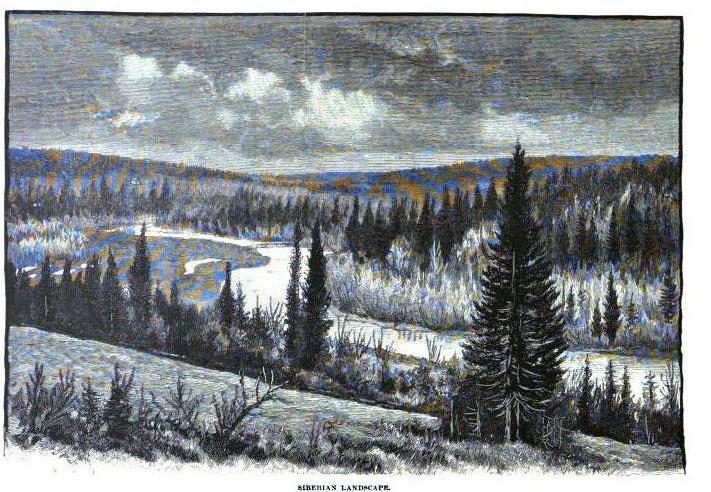
siberian landscape

George Kennan and his sled dogs traveled twenty-three days through the bleak, wintry wilderness of Siberia before they reached the tiny village of Anadyrsk. “The short winter day of three hours had long since closed and the night was far advanced,” he writes in his 1870 travel memoir Tent Life in Siberia and Adventures Among the Koraks and Other Tribes in Kamtchatka and Northern Asia, when “we drew near our final destination — the ultima Thule of Russian civilization.” Alerting Kennan to his imminent arrival was the sled dogs’ cheerful barking; he himself was lying listlessly and “nearly buried in heavy furs”on his sled, exhausted from weeks spent wandering the snow-blown steppes.

A crowd of spectators gathered around the weary American adventurer, whose hungry face sporting a beard of three-weeks’ growth and a frost-bitten forehead covered in “long ragged locks” provoked in them a respectful silence. In the center of this “fur-clad group” stood a priest with “long flowing hair and beard, dressed in a voluminous black robe, and holding above his head a long tallow candle which flared wildly in the cold night air.” The priest beckoned Kennan to follow him.

Kennan followed the priest into a small, tidy house. Its floors were carpeted in “soft, dark deer-skins in which one’s feet sank deeply at every step.” A fire blazed in one corner, and a “tiny gilt taper was lighted before a massive gilt shrine opposite the door.” On a small table was laid a meal of vodka, “cabbage-soup, fried cutlets, white bread and butter,” which Kennan shared with the priest and his family.

After this welcome repast Kennan spread out his bedclothes on the floor, undressed himself “for the second time in three weeks,” and retired. “The sensation of sleeping without furs, and with uncovered head,” he writes, “was so strange, that for a long time [I laid] awake, watching the red flickering fire-light on the wall, and enjoying the delicious warmth of soft, fleecy blankets, and the luxury of unconfined limbs and bare feet.”

What dessert Kennan enjoyed during that first meal after three weeks in the wilderness he did not record. Perhaps it was a dish of sweet Siberian crab apples like this one from the 1866 Dictionary of Daily Wants.

Stewed Siberian Crabs

Make a rich syrup with sugar, the juice and rind of lemons, a little brandy, and cloves. When this boils throw in the fruit [crab apples], which should be perfectly ripe. Let it simmer for a few minutes, then remove from the fire; and leave it to cool. Boil again, and continue doing so until the crabs become quite soft. Serve cool in the syrup.

Pickled Siberian Crabs

Gather the apples while they are still very hard. Remove the eyes, peel them, and put them into a brine of salt and water that will float an egg. Let them stand for six days more. Put them into a jar with a little mace. Boil some double distilled vinegar with sliced horseradish, a sliced nutmeg, some allspice, and a few cloves, and pour it boiling hot upon the apples. When quite cold put a cork into the jar. Boil the vinegar again every alternate day for ten days, and pour it each time boiling hot over the apples. When cold, cork the jar, and tie it down with a bladder. The pickle will not attain perfection till it has lain for three months.


Why Fast and Fermented Foods by Christine Baumgarthuber

Would you rather receive The Austerity Kitchen by email? Then sign up for my Substack.

And, if you’d like to help the Kitchen keep cookin’, please consider picking up copies of my books, Why Fast? and Fermented Foods.