
Today’s post appears at The New Inquiry. It relates Baron Thomas Babington Macaulay’s characterization of Samuel Johnson’s tremendous appetite for rotten hare — a gustatory peculiarity if there ever were one.
Today’s post appears at The New Inquiry. It relates Baron Thomas Babington Macaulay’s characterization of Samuel Johnson’s tremendous appetite for rotten hare — a gustatory peculiarity if there ever were one.
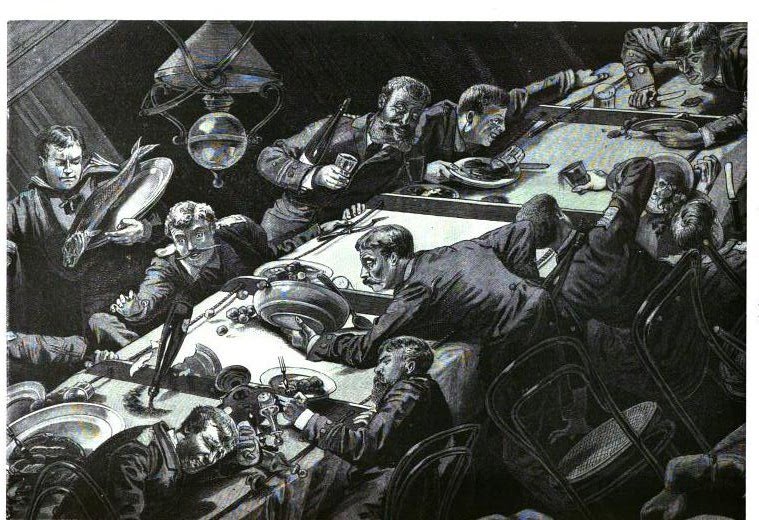
In his “bright little skit” (as one reviewer called it) Biscuits and Dried Beef: A Panacea (1894), Lindon H. Morehouse shares the adventures of a poor rector who decides “never to incur Indebtedness.” But this resolution proves difficult; the rector’s vestry are unapologetically tightfisted, often even neglecting to render the rector his due pittance of $800.00 per annum. To shame the vestry, the rector sends them invitations to what they suppose will be a lavish dinner. Expectant of toothsome morsels, they are instead greeted with the contents of the rector’s larder — biscuits and dried beef. Having learned their lesson, the vestry pay the rector’s stipend in full the next day.
During lean times, the rector and his wife subsist on roast beef, the virtues of which the rector wryly extols:
It seemed that in the early days of their housekeeping, Mrs. Forest had ordered, and cooked, an eight-pound roast of beef, and as a natural result, roast beef played an important part in their bill of fare for many days after. It had been a source of amusement, but it was one of that kind of “funny episodes” which lose much of their humor if referred to too often, and so a truce had been declared, and the subject was not to be again mentioned.
Roast beef played an important roles in many bills of fare throughout the the work week. The Sunday roast was an economical way to ensure meat figured in more weekday meals than not. A contributor to a 1902 edition of Good Housekeeping shares her recipes for weekday meals that incorporate Sunday roast leftovers. “The meat cakes for dinner [Monday] night were made from a part of the Sunday roast,” she writes, and “Tuesday being ironing day, I saved what was left of my roast for a browned stew on Wednesday.” What became of the roast on Thursday, Friday and Saturday is left to the reader’s imagination.
What Shall I Eat? A Housewife’s Manual (1892) offers a “very delicious” recipe for roast beef with Yorkshire pudding. The author suggests having a roast ready for Saturday, but Sunday will do just as well.
Roast Beef
Have your meat ready for roasting on Saturday, always. Roast upon a grating of several clean sticks (not pine) laid over the dripping-pan. Dash a cup of boiling water over the beef when it goes into the oven ; baste often, and see that the fat does not scorch. About three-quarters of an hour before it is done, mix the pudding.
Yorkshire Pudding.—One pint of milk, four eggs, white and yolks beaten separately; two cups of flour—prepared flour is best; one teaspoonful of salt. Use less flour if the batter grows too stiff.
Mix quickly; pour off the fat from the top of the gravy in the dripping-pan, leaving just enough to prevent the pudding from sticking to the bottom. Pour in the batter and continue to roast the beef, letting the dripping fall upon the pudding below. The oven should be brisk by this time. Baste the meat with the gravy you have taken out to make room for the batter. In serving, cut the pudding into squares and lay about the meat in the dish. It is very delicious.

Would you rather receive The Austerity Kitchen by email? Then sign up for my Substack.
And, if you’d like to help the Kitchen keep cookin’, please consider picking up copies of my books, Why Fast? and Fermented Foods.

In the small Thuringian forest village of Möhra, where Hans Luther (the father of Martin Luther) was born in a modest house on a narrow side street, Victorian journalist Henry Mayhew took a room in a hotel whose only virtue was a larder full of black pudding. The austere amenities Mayhew enjoyed there apparently planted the the seeds of what would eventually grow into a deep and abiding hatred of the German people, which he distilled into the two-volume German Life and Manners as Seen in Saxony at the Present Day: With an Account of Village Life-Town Life-Fashionable Life-Domestic Life-Married Life-School and University Life, &c., of Germany at the Present Time (1864).
Mayhew railed against almost everything about German life and manners. He found the faces and breath of the German baronesses dirty and stale, the carriages and state equipages inexcusably muddied, the language coarse and the homes slovenly. Even household pets elicited Mayhew’s disgust: “Never was such a race of domestic animals to be seen on the face of the earth,” he writes, “cats with back-bones not unlike a miniature ridge of the Alps, and dogs as thin and long-legged as French pigs, and as underbred as those in the streets of Constantinople.” For Mayhew, “filthy, barbarous Deutschland” was a commonwealth of noxious burghers and ailing animals.
German food was a source of constant vexation as well for this excitable journalist. He abhorred the German love of sour bread and root vegetables, and German meat he found nauseating, especially a “filthy fat called ‘speck.” He loathed how this “hump of black, baked pig-meat, stripped of every particle of fat, is not a very tempting-looking, nor even a very toothsome dish, to persons of the least refinement.”
German Life and Manners was a flop; readers and critics generously speculated Mayhew took leave of his senses while roving the German countryside. Nothing else could explain such an odd and irascible book from an otherwise circumspect writer. But for all its faults, it does remind us, albeit in a roundabout way, of Germany’s more charming culinary traditions, like this recipe for speck and potatoes from Die Küche im Deutschen Bürgerhause: Ausführlichste Anleitung für Anfänger in Kochen, Backen und Einmachen (1901), a dish that surely would have sent Henry Mayhew into paroxysms of revulsion.
Speck Potatoes
12-15 medium potatoes
10 grams salt
1 liter meat stock, or hot salt water
30 grams butter
20 grams smoked pork speck (bacon), finely chopped
2 small onions, finely chopped
1 bunch parsley
Wash the potatoes, peel them, cut them into thick pieces and put them into water. Put the butter in a large dutch oven, heat it over medium heat and, once the butter melts, throw in the chopped onions with the finely chopped speck, and roast until light brown. Drain the potatoes in a colander and put them immediately into the hot fat with the bacon and onions. Add the salt. Mix everything together and allow to cook for fifteen minutes. Then add the meat stock (or salt water), cover the dutch oven, and let the mixture cook until the potatoes are soft. Make sure to stir every so often so the potatoes don’t stick to the bottom of the dutch oven. The dish should be ready in half an hour. Once it is cooked through, sprinkle chopped parsley over it. Serve these potatoes with beef steak, sausages, or other meat dishes.
Would you rather receive The Austerity Kitchen by email? Then sign up for my Substack.
And, if you’d like to help the Kitchen keep cookin’, please consider picking up copies of my books, Why Fast? and Fermented Foods.
 The Austerity Kitchen