Siberian Crab Apples

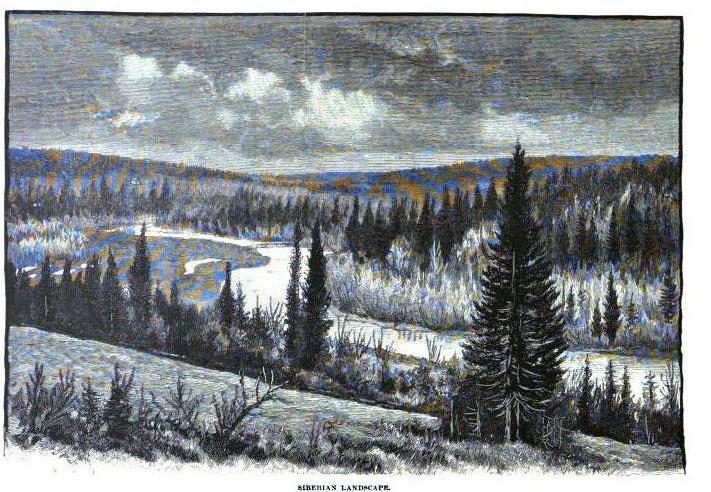
siberian landscape

George Kennan and his sled dogs traveled twenty-three days through the bleak, wintry wilderness of Siberia before they reached the tiny village of Anadyrsk. “The short winter day of three hours had long since closed and the night was far advanced,” he writes in his 1870 travel memoir Tent Life in Siberia and Adventures Among the Koraks and Other Tribes in Kamtchatka and Northern Asia, when “we drew near our final destination — the ultima Thule of Russian civilization.” Alerting Kennan to his imminent arrival was the sled dogs’ cheerful barking; he himself was lying listlessly and “nearly buried in heavy furs”on his sled, exhausted from weeks spent wandering the snow-blown steppes.

A crowd of spectators gathered around the weary American adventurer, whose hungry face sporting a beard of three-weeks’ growth and a frost-bitten forehead covered in “long ragged locks” provoked in them a respectful silence. In the center of this “fur-clad group” stood a priest with “long flowing hair and beard, dressed in a voluminous black robe, and holding above his head a long tallow candle which flared wildly in the cold night air.” The priest beckoned Kennan to follow him.

Kennan followed the priest into a small, tidy house. Its floors were carpeted in “soft, dark deer-skins in which one’s feet sank deeply at every step.” A fire blazed in one corner, and a “tiny gilt taper was lighted before a massive gilt shrine opposite the door.” On a small table was laid a meal of vodka, “cabbage-soup, fried cutlets, white bread and butter,” which Kennan shared with the priest and his family.

After this welcome repast Kennan spread out his bedclothes on the floor, undressed himself “for the second time in three weeks,” and retired. “The sensation of sleeping without furs, and with uncovered head,” he writes, “was so strange, that for a long time [I laid] awake, watching the red flickering fire-light on the wall, and enjoying the delicious warmth of soft, fleecy blankets, and the luxury of unconfined limbs and bare feet.”

What dessert Kennan enjoyed during that first meal after three weeks in the wilderness he did not record. Perhaps it was a dish of sweet Siberian crab apples like this one from the 1866 Dictionary of Daily Wants.

Stewed Siberian Crabs

Make a rich syrup with sugar, the juice and rind of lemons, a little brandy, and cloves. When this boils throw in the fruit [crab apples], which should be perfectly ripe. Let it simmer for a few minutes, then remove from the fire; and leave it to cool. Boil again, and continue doing so until the crabs become quite soft. Serve cool in the syrup.

Pickled Siberian Crabs

Gather the apples while they are still very hard. Remove the eyes, peel them, and put them into a brine of salt and water that will float an egg. Let them stand for six days more. Put them into a jar with a little mace. Boil some double distilled vinegar with sliced horseradish, a sliced nutmeg, some allspice, and a few cloves, and pour it boiling hot upon the apples. When quite cold put a cork into the jar. Boil the vinegar again every alternate day for ten days, and pour it each time boiling hot over the apples. When cold, cork the jar, and tie it down with a bladder. The pickle will not attain perfection till it has lain for three months.


Why Fast and Fermented Foods by Christine Baumgarthuber

Would you rather receive The Austerity Kitchen by email? Then sign up for my Substack.

And, if you’d like to help the Kitchen keep cookin’, please consider picking up copies of my books, Why Fast? and Fermented Foods.
A Fried Fish Shop in London

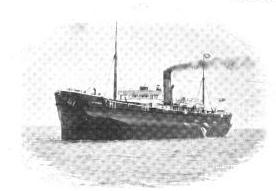
ocean steamer

“At last, after so many years, I am about to realize the dream of my life–a visit to lands beyond the sea,” James Hale Bates, the American originator of the mercantile registry business, wrote on May 1, 1889. He recorded his adventures on the high seas in Notes of Foreign Travels, which he published privately in 1891. “This cool, bright morning, at half-past six, finds me with wife, daughter Betty and niece Mary on board the huge steamer ‘City of New York,'” it begins, “which at the above hour slowly swings from her mooring into the Hudson at Pier 43, and carefully feels her way down the river and harbor, through the Narrows, into the broad Atlantic.”

Continue reading

The Peabody Family Thanksgiving

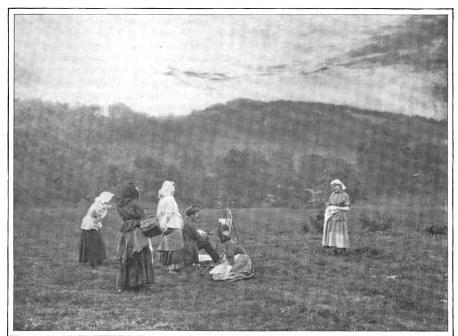
a family's outdoor excursion


In his 1850 novella Chanticleer: A Thanksgiving Story of the Peabody Family, Cornelius Mathews relates the happy events attending one family’s holiday. He describes how on the morning of the feast the matron of the house stoked a great fire on the hearth for the turkey, and one in the oven for the pies. The table, he writes, was made ready for delectable piles of “home-made bread, basins of apple-sauce, pickles … and potatoes of vast proportion and mealy beauty,” in anticipation of which the entire household patiently waited.

This patient waiting Mathews characterizes as a sort of drowsy peace affecting not only the Peabodys, but their chattels, possessions — indeed, their entire neighborhood — as well:

The morning of the day of Thanksgiving came calm, clear and beautiful. A stillness, as of heaven and not of earth, ruled the wide landscape. The Indian summer, which had been as a gentle mist or veil upon the beauty of the time, had gone away a little — retired, as it were, into the hills and back country, to allow the undimmed heaven to shine down upon the happy festival of families and nations. The cattle stood still in the fields without a low; the trees were quiet as in friendly recognition of the spirit of the hour; no reaper’s hook or mower’s scythe glanced in the meadow, no rumbling wain was on the road. The birds alone, as being more nearly akin to the feeling of the scene, warbled in the boughs.

Though such tranquil scenes occur all too rarely in our busy age, it is still possible to enjoy the Thanksgiving holiday’s cornucopia of cheerful and delectable dishes, like this recipe for roast turkey from the 1871 De Witt’s Connecticut Cook Book, and Housekeeper’s Assistant.

Roast Turkey

Take out the inwards, and wash the inside and outside of the turkey.

Prepare a dressing in the following manner: Have sufficient bread soaked in cold water to fill the turkey ; when soft, drain off the water and mash it fine ; mix with it a large spoonful of melted butter, or a little raw chopped pork ; season it with salt and pepper ; add sweet herbs and an onion, if you like. An egg in the dressing makes it cut smoothly. Any kind of cooked meat chopped fine, and mixed with the dressing, improves it. A dressing made of potatoes boiled fresh, and mashed, with a little salt and butter mixed with it, makes a good dressing for turkey or other kinds of poultry.

Fill the crop and body with the the dressing, sew it up, tie up the legs and wings, rub on a little butter and salt. Roast it from two to three hours, according to its size. Twenty-five minutes to every pound is a good rule. It should be roasted slowly at first, and basted frequently, having about two-thirds of a pint of water in the dripping-pan. The inwards should be boiled by themselves, they require a great deal of cooking ; use the liquor in which, they are boiled for a gravy to the turkey, adding a little of the drippings of the turkey; thicken it, when it boils, with mixed flour and water; season with salt and pepper; add thyme or summer savory.

Carving the turkey:

A roast or boiled turkey may be made to serve a great number of people, if carved with judgment, or it may be used so extravagantly as to be expended before half the guests have been served.

A sharp knife should be passed clearly down to the bone, almost close to the wing, and then a thin slice is taken out from between this and the breast, continuing the same plan until the whole side is exhausted, after which the other side is served in the same way. A portion of the force-meat is also placed in each plate ; and if there are sausages or balls, a part of each of them.

When both sides of the breast are used up, and the party are not all served, the legs must be taken off by carrying the knife backward between them and the body, until it is stopped by the joint, when by means of the fork stuck in the leg it is severed from the body, the knife completing the removal by its edge. If possible, however, the carver should endeavor to avoid having recourse to the legs, and it is usually either a reproach upon the mistress for not procuring a sufficiently large bird, or upon his own powers of carving, if such an expedient is unavoidable. In dividing the leg into its two portions, the knife should be used against the inside of the joint, where it enters with much less difficulty than on the outside. After this in a large bird, the meat is cut off in sections for serving.


Why Fast and Fermented Foods by Christine Baumgarthuber

Would you rather receive The Austerity Kitchen by email? Then sign up for my Substack.

And, if you’d like to help the Kitchen keep cookin’, please consider picking up copies of my books, Why Fast? and Fermented Foods.