
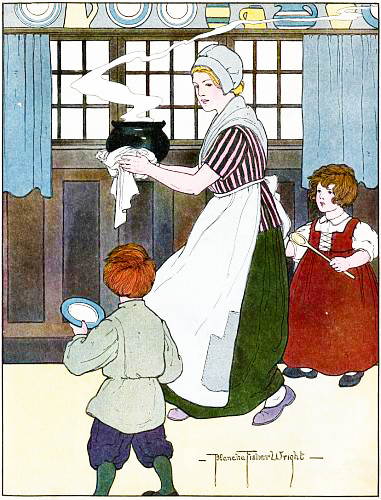
“Pease pudding hot, Pease pudding cold,
Pease pudding in the pot — nine days old.
Some like it hot, some like it cold,
Some like it in the pot, nine days old.”
While the origins of “Pease Pudding Hot” are unknown, the dish described in the rhyme is a thick, smooth paste made from dried peas or lentils. Traditionally served with boiled bacon or a type of sausage called a saveloy, it appeared frequently on the tables of the lower classes, where, more often than was desired, it sat in a pot for nine days (or more), heated and then reheated until finished off.
Was nine-day-old pease pudding palatable, you ask? The July 24, 1884 edition of Knowledge, An Illustrated Magazine of Science reports that aged pease pudding was, in fact, a great treat. It mentions a reader who “has seven dishes of [pease pudding] in his larder, corresponding to the days of the week [and] each being seven days old.” The brave reader claims old pease pudding is easier to digest than new. The editor of Knowledge, however, warns the nursery rhyme offers sage advice: Nine days is the limit pease pudding can be kept in a larder before it’s likely to make the unwary diner ill.
The following recipe for pease pudding comes from Maria Eliza Ketelby Rundell’s The New Family Receipt-Book (1810). Serve pease pudding with boiled pork or, if you are vegetarian, by itself. Do not, however, keep your pease pudding for more than a day or two without refrigeration.
Pease Pudding Hot
Take a pint of yellow split pease, and after tying them loosely in a cloth, boil them in water until they become tender. Then rub them through a cullender [colander] or hair sieve [sieve], and add to the pulp a bit of butter, a spoonful of cream, two eggs, and white pepper and salt. After being uniformly mixed, put the pease into a cloth; tie tightly, and boil for the space of half an hour, to make the ingredients set.

Would you rather receive The Austerity Kitchen by email? Then sign up for my Substack.
And, if you’d like to help the Kitchen keep cookin’, please consider picking up copies of my books, Why Fast? and Fermented Foods.

 The Austerity Kitchen