Pease Pudding Hot

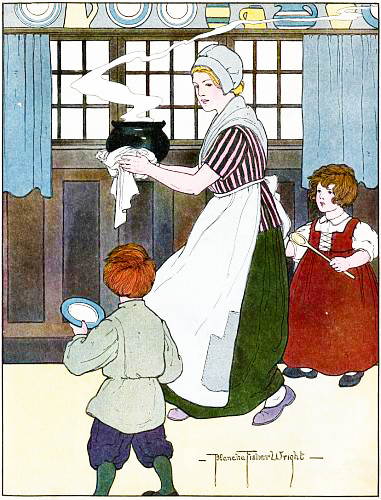
Illustration of woman serving pease porridge

“Pease pudding hot, Pease pudding cold,
Pease pudding in the pot — nine days old.
Some like it hot, some like it cold,
Some like it in the pot, nine days old.”

While the origins of “Pease Pudding Hot” are unknown, the dish described in the rhyme is a thick, smooth paste made from dried peas or lentils. Traditionally served with boiled bacon or a type of sausage called a saveloy, it appeared frequently on the tables of the lower classes, where, more often than was desired, it sat in a pot for nine days (or more), heated and then reheated until finished off.

Was nine-day-old pease pudding palatable, you ask? The July 24, 1884 edition of Knowledge, An Illustrated Magazine of Science reports that aged pease pudding was, in fact, a great treat. It mentions a reader who “has seven dishes of [pease pudding] in his larder, corresponding to the days of the week [and] each being seven days old.” The brave reader claims old pease pudding is easier to digest than new. The editor of Knowledge, however, warns the nursery rhyme offers sage advice: Nine days is the limit pease pudding can be kept in a larder before it’s likely to make the unwary diner ill.

The following recipe for pease pudding comes from Maria Eliza Ketelby Rundell’s The New Family Receipt-Book (1810). Serve pease pudding with boiled pork or, if you are vegetarian, by itself. Do not, however, keep your pease pudding for more than a day or two without refrigeration.

Pease Pudding Hot

Take a pint of yellow split pease, and after tying them loosely in a cloth, boil them in water until they become tender. Then rub them through a cullender [colander] or hair sieve [sieve], and add to the pulp a bit of butter, a spoonful of cream, two eggs, and white pepper and salt. After being uniformly mixed, put the pease into a cloth; tie tightly, and boil for the space of half an hour, to make the ingredients set.


Why Fast and Fermented Foods by Christine Baumgarthuber

Would you rather receive The Austerity Kitchen by email? Then sign up for my Substack.

And, if you’d like to help the Kitchen keep cookin’, please consider picking up copies of my books, Why Fast? and Fermented Foods.
From Hermann, Missouri: Depression Caramels

In the early 1830s, the German Settlement Society of Philadelphia traveled to the lush and rugged Gasconade River Valley. There they founded the colony of Hermann, Missouri; the Society thought the Gasconade Valley, with its green rolling hills, resembled their beloved valley of the Rhine River, and they wanted to establish a German community devoted to farming and commerce in the heart of it.

The colony quickly grew into a town of successful vintners. The rocky hills of the Gasconade Valley, while inimical to farming, proved perfect for cultivating grapes, and large vineyards were planted along the hillsides.

Business was brisk in Hermann until Prohibition, when the vineyards were forced to close. So devastating did Prohibition prove to the town that residents said the Great Depression ravaged Hermann ten years before it hit the rest of the country.

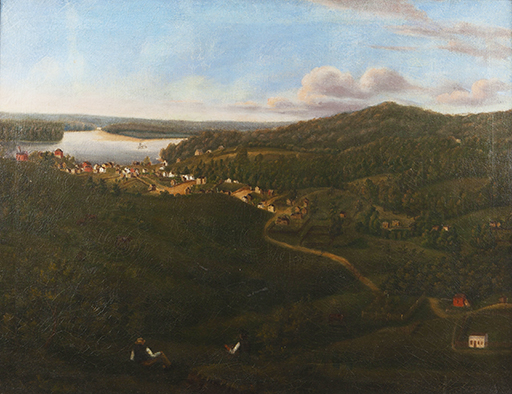
Landscape painting of Hermann Missouri circa 1850
Vista on Hermann, Missouri ca. 1850 via Wikimedia Commons

The following recipe for caramels comes from an old Hermann farming family. Dated 1938, it was found handwritten in a cookbook. Made from readily available ingredients, the caramels were a simple delight during the dark days of the Depression.

Hermann Caramels

2 cups sugar
1 can (1 cup) corn syrup
1 can (1 cup) milk
Pinch of salt
1/2 cup butter
1 tsp vanilla
Nuts, if desired

Put sugar, syrup, butter and salt in a saucepan. Cook into a clear, thick consistency. Add milk gradually so as to not stop the boiling. Cook until a firm ball forms. Add vanilla and nuts. Place in a buttered pan until cool. Put on a marble slab or oiled paper [wax paper] and cut into 1-inch squares. Wrap in oiled paper.


Why Fast and Fermented Foods by Christine Baumgarthuber

Would you rather receive The Austerity Kitchen by email? Then sign up for my Substack.

And, if you’d like to help the Kitchen keep cookin’, please consider picking up copies of my books, Why Fast? and Fermented Foods.

Bruegel’s Harvest Meal: Buttermilk Porridge

Worn out from their morning’s work in the wheat fields, the group of peasants in Pieter Bruegel the Elder’s The Harvesters (1565) relax under a young tree and enjoy a meal of bread, cheese and porridge. Some peasants continue to work, tirelessly threshing a golden field of wheat that stretches far into the distance. They remind those who eat of the labor required to produce the hearty loaves of bread and creamy bowls of porridge enjoyed under the tree.

Bruegel Harvesters Sour Milk Porridge
The Harvesters, 1565

Bruegel was a master in his painter’s guild, but contemporaries called him “Pieter the Peasant” as he liked to dress in peasant’s garb and attend peasant weddings and celebrations. His paintings then depict a world of lived experience. The meal enjoyed by the peasants, amid tall sheaves of wheat on a warm summer’s day, was likely savored by Bruegel as well.

The peasants in The Harvesters are feasting on a sour milk pap–a common meal in the sixteenth century. Should you wish to enjoy a similar dish, here’s a traditional recipe for a Dutch buttermilk porridge.

Buttermilk Porridge

4 1/2 cups (1 liter) buttermilk
3 ounces (60 grams) flour
molasses or stroop (syrup)
salt

Pour the flour into a bowl and add a pinch of salt. Pour in half the buttermilk and mix into a smooth paste. Boil the remaining buttermilk over medium heat and add the flour paste gradually, stirring constantly. Serve with stroop (a fruit syrup is particularly good) or molasses.


Why Fast and Fermented Foods by Christine Baumgarthuber

Would you rather receive The Austerity Kitchen by email? Then sign up for my Substack.

And, if you’d like to help the Kitchen keep cookin’, please consider picking up copies of my books, Why Fast? and Fermented Foods.