Thrifty Winter Delights: Gribenes

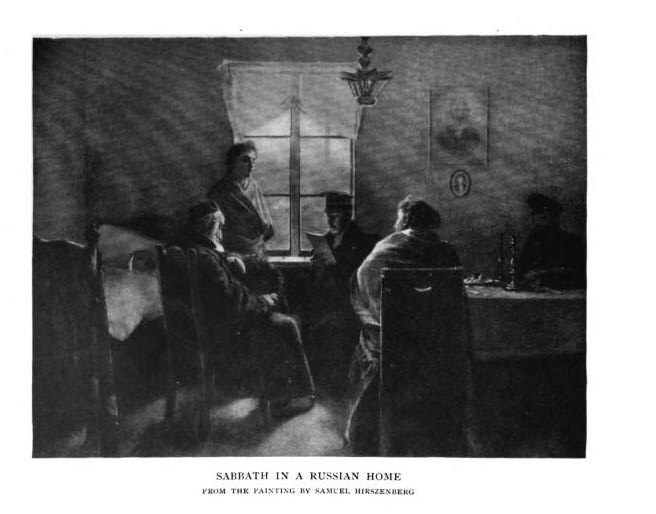
Sabbath in a Russian home

The Chanucah table is laden with culinary delights. The 1914 Jewish Life in Modern Times, by Israel Cohen, lovingly documents the festivities and tasty dishes associated with this winter holiday. “Apart from his own peculiar dishes,” Cohen writes, “the observant Jew also adopts those of his native country so far as they can be allowed by his dietary laws, and he imports them into any land to which he may emigrate. Thus in the Jewish quarter of a Western city, one may see displayed in the shop windows the large dark-brown loaves reminiscent of the Russian Pale, the kegs of olives, cucumbers and gherkins that hail from Holland, and the tureens of sauerkraut and variegated sausages that owe their origin to Germany.” Despite these influences from other lands, during Chanucah traditional dishes are served by Jewish families. The “cuisine in Jewry,” Cohen continues, “is as distinctive an element in its social life as in that of any nation living in a land of its own.”
Below is a recipe from The Second Ave Deli Cookbook for gribenes, a dish popular during Chanucah. It is a dish comprised of fried scraps of fowl (the name literally means “scraps”) and is served with potato pancakes or rye bread. It is a wonderfully thrifty way to use up leftover chicken.

Gribenes

4 cups chicken fat and skin, cut into 1/2-inch pieces or smaller
Kosher salt
Pinch of pepper
1 cup onion rings, about 1/8-inch thick

Wash fat and skin well in a colander, and pat dry. Place in a heavy skillet, and sprinkle lightly with salt and pepper. Cook, uncovered, over low heat (you can turn it up a bit once the fat has begun melting). When the fat starts to melt and get slightly brown, add onions (and garlic cloves if you like), and continue cooking until onions and cracklings are golden brown and crunchy. When partially cooled, strain over a bowl to remove onions and cracklings, and refrigerate them in a covered glass jar. Poor schmaltz into another jar, cover, and refrigerate.


Why Fast and Fermented Foods by Christine Baumgarthuber

Would you rather receive The Austerity Kitchen by email? Then sign up for my Substack.

And, if you’d like to help the Kitchen keep cookin’, please consider picking up copies of my books, Why Fast? and Fermented Foods.

Wine and Wartime Foods: Meat Loaf

wartime propaganda about food waste

“Yes, wine does things for plain war foods,” a 1944 advertisement for the American Wine Advisory Board claims. “Don’t give up your friends!,” it continues, “Keep on having them over to your house. Remember–it’s good company, not party food, that makes a dinner!” But still the Wine Advisory Boards recommends one add a splash of wine to bland, wartime fare to enliven the party: “If you’ll make your meat loaf with a little red table wine, you’ll find it becomes banquet fare. It’s that way with other wartime dishes, too. With a touch of wine in the cooking, you can glorify the flavor of the plainest food.”

Below is a wartime recipe from the Wine Advisory Board for meat loaf. Use an inexpensive wine, and serve the finished dish with mashed potatoes and a vegetable.

Fancy Wartime Meat Loaf

To prepare it, you combine 3/4 lb. ground beef, lamb or veal with 3/4 cup rolled oats and 1/2 cup Burgundy or Claret wine. Add 3 tbsps. chopped onion, 1 1/2 tsps. salt, 1/4 tsp. pepper, 1/4 tsp. poultry seasoning, 1 beaten egg, and 2 tbsps. butter or bacon drippings. Pack into greased small loaf pan, and bake in moderate oven (350 degrees F.) 1 hour or until done. Serves 4 or 5.


Why Fast and Fermented Foods by Christine Baumgarthuber

Would you rather receive The Austerity Kitchen by email? Then sign up for my Substack.

And, if you’d like to help the Kitchen keep cookin’, please consider picking up copies of my books, Why Fast? and Fermented Foods.

Ancient Fare: Pinto Bean Cakes with Cracked Wheat in Sour Cream

stalk of wheat, schematic illustration

Life magazine’s 1958 Picture Cook Book presents the reader with a vast array of nourishing traditional dishes. One chapter, entitled “Ancient Fare,” contains dozens of simple, yet delicious, recipes for legumes and grains. “All of these foods are best in simple recipes,” states the introduction to the chapter. “Their flavor is brought out by straightforward butter and herb sauces,” it continues, “but it can be enhanced by the addition of mushrooms, sour cream, almonds or pungent sweet and sour sauce. Cracked wheat, buckwheat groats and pearl barley are coarser than the usual breakfast cereals and consequently have more flavor and texture. The nutty taste of wheat and buckwheat makes them excellent side dishes with hearty beef roasts, and delicately flavored barley does particularly well with ham. These foods are often as good cold as they are hot.”

Below is a recipe from the Picture Cook Book for pinto bean cakes with cracked wheat in sour cream. Both dishes are economical and filling.

Pinto Bean Cakes

2 cups dried pinto beans
1/4 teaspoon crushed red pepper or 1 chili pepper, minced
2 garlic cloves, chopped
1/2 cup butter
1 teaspoon salt

Soak beans overnight in water to cover. Simmer them in the soaking water with salt for 2 hours. Drain beans and chop them coarsely or put them through a food grinder using a coarse blade. Add red pepper and garlic. Shape into 12 cakes and saute in butter for 10 minutes or until golden brown. Lima, navy or Great Northern beans may be substituted for pinto beans.

Cracked Wheat with Sour Cream

2 cups cracked wheat
1 cup sour cream
1/2 cup butter
1/2 cup olive oil
3 cups chicken bouillon [can substitute vegetable bouillon]

Saute mushrooms and onion in butter for five minutes or until lightly browned, stirring occasionally. Add cracked wheat and cook for 5 minutes, stirring constantly. Add bouillon, salt and pepper. Bring to a boil, reduce heat, cover and simmer 30 minutes, stirring occasionally. Serves 6.


Why Fast and Fermented Foods by Christine Baumgarthuber

Would you rather receive The Austerity Kitchen by email? Then sign up for my Substack.

And, if you’d like to help the Kitchen keep cookin’, please consider picking up copies of my books, Why Fast? and Fermented Foods.