Eat and Grow Thin: Vance Thompson’s Mahdah Recipes

sideshow fat man, illustration

Vance Thompson hated his portly figure. So he set about devising a novel way to lose his excess poundage. He eschewed all starches, dairy products, spirits and sugars. Even fruit was scratched from the list of acceptable comestibles. On the eve of the Great War, and after meeting with great success on his own front (he lost the excess poundage), Thompson published a book on the subject, Eat and Grow Thin: The Mahdah Menus.

Eat and Grow Thin is a most compelling diet book. Thompson prefaces his collection of prudent yet tasty recipes with riveting accounts of the trials and tribulations suffered by those cursed with a surfeit of adipose flesh. He dwells longest on the life of fellow writer and critic G.K. Chesterton, who, Thompson says, “wearing a bracelet for a ring [Chesterton] is a subject for tears, not laughter — jest he never so waggishly!”

Chesterton’s situation is truly no laughing matter. These corpulent men, Thompson goes on to inform us, suffer terribly: “If one should sink a shaft down to his heart — or drive a tunnel through to it–one would discover that it is a sad heart, black with melancholy. Down there, deep under the billowy surface of the man, all is gloom.” Indeed, the overweight man cannot even indulge in love with dignity; while “fierce burn the fires of love within him,” Thompson writes, “the fiercer they burn the faster flees the terrified girl — for he looks like a vat of boiling oil; and that is a fearsome thing to fall into.” The lover, thwarted by his girth, is left to endure yet another evening alone: “So, wrapped in tallow, the poor lover goes his sebaceous way — wearing his maiden aunt’s bracelet for a ring.”

One might call Vance Thompson unjust, until it is remembered that he speaks with all the bitterness of a critic schooled in polite society’s more cruel humiliations. And with this in mind, the generosity with which he shares his fat-melting recipes compensates for whatever slings and arrows he hurls at the corpulent in Eat and Grow Thin. Take, for instance, his delightfully savory recipe for mutton dolmas, a recipe that a less generous cook would have stored away in darkest secrecy.

Serve Thompson’s mutton dolmas with a dry red wine and a nice rocket salad. If you wish to enjoy this dish without a shred of weight on your conscience, follow Thompson’s advice to “use very little butter, and no oil, fats or grease” in its preparation. And if you wish to curtail your consumption of inebriating liquids, hunt down Thompson’s Drink and Be Sober, which he published a year after Eat and Grow Thin.

Mutton Dolmas

Take the tender leaves of a young cabbage, place three or four together and fill with the following mixture:

Two pounds of raw mutton hashed through the meat-chopper, two large onions, one-half cup chopped parsley, salt and paprika. Stir in three beaten eggs, form the mixture into oblong meat balls, roll and tie in thinly-buttered cabbage leaves. Place the Dolmas in a bake dish in layers with a plate to press them down and keep in place. Cover with the stock of any meat and cook slowly one and a half hours. When done make a sauce of the juice with the yolks of eggs or simply pour over the Dolmas. The Dolmas are very good served with tomato sauce. A can of Campbell’s condensed tomatoes, to which has been added a boiled onion, finely chopped, and a bay leaf for flavor, makes an excellent and quickly prepared tomato sauce.


Why Fast and Fermented Foods by Christine Baumgarthuber

Would you rather receive The Austerity Kitchen by email? Then sign up for my Substack.

And, if you’d like to help the Kitchen keep cookin’, please consider picking up copies of my books, Why Fast? and Fermented Foods.

Eggs Samuel Butler

brooklyn bookshop in the early 20th century

In Christopher Morley’s novel The Haunted Bookshop (1919), the diminutive Brooklyn bookseller Roger Mifflin finds himself, one cold November evening, caught up in a whirlwind of international espionage. German spies, amorous advertising men, and pouting flaxen-haired heiresses revolve in and out of Morley’s novel, which provides an antic glimpse into New York life during the 1920s.

In one of the novel’s more delightful moments, Roger Mifflin prepares dinner for a young advertising man come wandering into his shop. The meal, which Mifflin christens “Eggs Samuel Butler,” echoes those simple wartime repasts of only a year or two before. And as the two men enjoy Mifflin’s culinary creation, they discuss how literature could help prevent another such world catastrophe. Mifflin believes that peace can only come about once Thomas Hardy’s The Dynasts becomes required reading. In reference to an upcoming peace conference, Mifflin proposes that “if every delegate to the Peace Conference could be made to read it [The Dynasts] before the sessions begin, there will be no more wars.” Mifflin even goes so far as to hypothesize that “if enough thoughtful Germans had read The Dynasts before July, 1914, there would have been no war.”

Whether Hardy’s novel could have prevented the Great War is up for debate, but there is no question that Eggs Samuel Butler is a tasty dish. “The apotheosis of hen fruit,” as Mifflin calls his invention, Eggs Samuel Butler is quite simple to prepare. Intended “for the notebook of housewives,” the recipe is generously provided for the reader, which is as follows: “A pyramid, based upon toast, whereof the chief masonries are a flake of bacon, an egg poached to firmness, a wreath of mushrooms, a cap-sheaf of red peppers; the whole dribbled with a warm pink sauce of which the inventor retains the secret.” A more exact version of the recipe can be found below. Mifflin suggests serving Eggs Samuel Butler with a nice “California catawba,” and finishing the meal with a dessert of “apple sauce, gingerbread, and coffee.”

Eggs Samuel Butler

8 slices of toast
4 eggs, poached
1 pound mushrooms, thinly sliced
3 red peppers, diced
1/2 pound bacon, cooked until crisp
2 tablespoons olive oil
1 tablespoon butter
Salt and pepper to taste

Fry the mushrooms in olive oil and butter in a large pan. Add the red peppers and cook until soft. In separate pan fry the bacon until crisp. Poach eggs. On each plate, place two slices of toast. Place three or four slices of bacon on each slice of toast, then an egg, mushrooms and top with the red peppers. Serve covered with a hollandaise sauce favored with paprika, if desired.


Why Fast and Fermented Foods by Christine Baumgarthuber

Would you rather receive The Austerity Kitchen by email? Then sign up for my Substack.

And, if you’d like to help the Kitchen keep cookin’, please consider picking up copies of my books, Why Fast? and Fermented Foods.

Braised Beef Heart

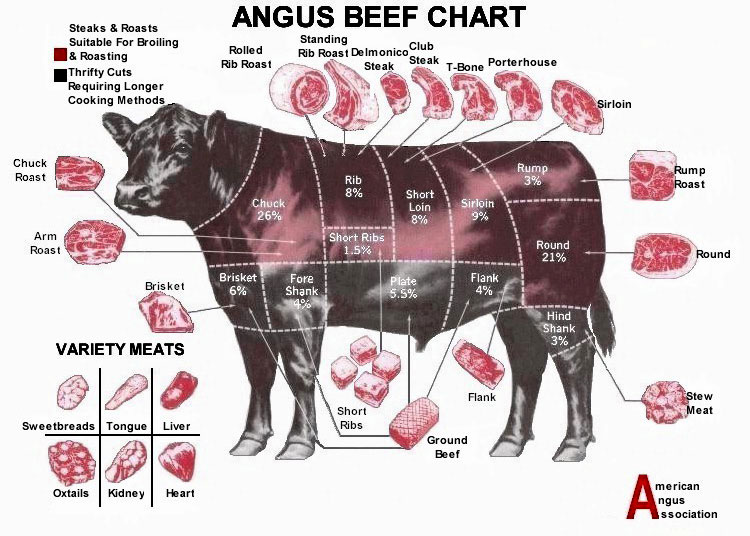
angus beef chart for butchers

“Most housekeepers get into a ‘rut’ and buy the same steaks, chops and roast each week, having no repertoire of cheaper dishes,” an 1888 edition of Table Talk laments. The author suggests that “a beef’s heart or a braised calf’s liver make an excellent and economical change.” Certainly beef heart is one of the more neglected pieces of meat. And this is indeed a sad fact. For beef heart, if properly cooked, is quite delicious — and exceptionally nutritious.

Here’s an economical and tasty recipe for braised beef heart from food.com. Serve this dish with a green salad and a crusty loaf of sourdough bread.

Braised Beef Heart

3 lbs beef heart
3 tablespoons onion soup mix
1 cup water
2 tablespoons vegetable oil
1 medium onion
1 teaspoon prepared mustard
1 cube beef bouillon
1/2 cup breadcrumbs

1. Trim any fat off the heart. Use a pair of kitchen scissors to cut off any large pieces of the connective tissue around the top of the meat.

2. Roll into a roast form and tie with string.

3 Brown in the oil on all sides.

4. Put in a dutch oven and add the onion, cut into about 8 pieces, and all the other ingredients, except the bread crumbs.

5. Bring to a boil, reduce heat and simmer for 4 hours, turning every hour.

6. After 2 hours, add the bread crumbs.

7. When done, remove heart and use an immersion blender or regular blender to smooth the gravy. If desired, you can thicken the gravy some more with a water and flour mixture, bringing it to the boil.

8. Slice the heart lengthwise into 1/4″ slices.


Why Fast and Fermented Foods by Christine Baumgarthuber

Would you rather receive The Austerity Kitchen by email? Then sign up for my Substack.

And, if you’d like to help the Kitchen keep cookin’, please consider picking up copies of my books, Why Fast? and Fermented Foods.