Porridge for One: The Tale of the Grub Street Hermit

Henry Welby, The Grub Street Hermit


In his youth Mr. Henry Welby, the man who would later become known as the “Grub Street Hermit,” enjoyed riches, talents, and, above all, popularity. Contemporary accounts describe Welby as a sympathetic gentlemen much beloved in his neighborhood of Grantham. Yet, despite such esteem, Welby at around age forty decided to leave his tranquil home nestled among the gentle green hills of Lincolnshire and move to colorful, riotous London.

What happened to Welby in London remains for the most part a mystery; all that is known is that he became a hermit. A curious document published in 1637 attempts to untangle the strange knot of events that led to Welby’s retreat into solitude. “This Gentleman, Master Henry Welby, was Forty Years of Age before he took this solitary Life,” the document reports.

Those who knew him, and were conversant with him in his former Time, do report, that he was of a middle Stature, a Brown Complexion, and of a Pleasant Cheerful Countenance. His Hair (by reason no Barber came near him for the Space of so many Years) was much overgrown; so that he, at his Death, appeared rather like a Hermit of the Wilderness, than Inhabitant of a City. His Habit was plain, and without Ornament; of a sad-colored Cloth, only to defend him from the Cold, in there could be nothing found either to express the least Imagination of Pride or Vain-Glory.

The document goes on to speculate that it was an attempt on Welby’s life, by Welby’s brother of all people, that sent him into solitude, where he remained until his dying day. Welby took a rambling house in the lower end of Grub Street, near Cripplegate. He chose to inhabit only three rooms — one for meals, one for rest, one for study — and gave his servants dominion over the rest of the house. Welby carefully protected his solitude. He arranged his daily habits so that when he dined his servants would be in the bedchamber, preparing his bed or lighting the grate; when he retired for the evening they would be in the dining room, clearing away dishes. Such was his habit for forty-four years, it was said.

Welby’s meals were as austere and as strictly ordered as his life. He “never tasted Fish nor Flesh” and he never drank either “Wine or Strong Water.” His chief food was oatmeal boiled with water, which in summer was accompanied by a “Sallad of some cool, choice Herbs.” On days when craved additional nourishment, Welby ate the “Yolk of a Hen’s Egg” (but no part of the white) and crustless bread. His drink of choice was four-shilling beer. Sometimes he ate “Suckets,” or sugar plums, and “Red Cow’s Milk.”

Henry Welby’s recipe for hermit’s porridge has, unfortunately, been lost to history. But Benjamin Smith Lyman’s cookbook Vegetarian Diet and Dishes (1917) presents an appetizing recipe for oatmeal porridge sure to tickle the palate of any London hermit.

Oatmeal Porridge

Let half a pint of oatmeal steep in about a pint of water over night. In the morning, boil it an hour or more, regardless of the twenty minutes prescribed on the package as enough. It can hardly be cooked too much. Add salt to the water, if you like. Eat with sugar and milk (or terralac) or butter (or a palatable oil); and slices of banana, or apple sauce, or other fruit jam or marmalade, mixed with it, go well. Or figs may be cooked in the porridge; and a spiced steam pudding is sometimes made with the oatmeal.


Why Fast and Fermented Foods by Christine Baumgarthuber

Would you rather receive The Austerity Kitchen by email? Then sign up for my Substack.

And, if you’d like to help the Kitchen keep cookin’, please consider picking up copies of my books, Why Fast? and Fermented Foods.
An Autumn Treat: Baked Pumpkin with Milk

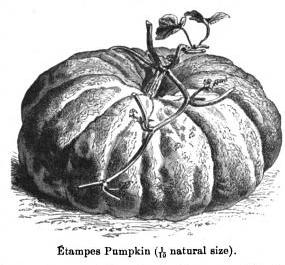
Étampes Pumpkin, illustration

A 1903 article from the American Kitchen Magazine tells us that in days past families enjoyed a delicious and unusual supper dish. “From a hard-shelled pumpkin,” the author writes, “a section was cut around the stem, thus making a cover, like that of the Jack-o’-lantern, the seeds and fibers were scraped out, and the space filled with rich, sweet milk.” The pumpkin’s top was “replaced and the pumpkin was put into the brick oven, where it stayed for hours until the tissues of the gourd were soft and had absorbed much of the milk.”

Serving this dish presented no unnecessary mess; the cooked pumpkin was simply placed on the table, its hard shell acting as a bowl. Diners then scooped out a bit of pulp and a bit of milk, and ate the two together like “baked sweet apples and milk.”

Below is a similar recipe from Hispanic Kitchen. It originates from Mexico and is usually served in autumn at Day of the Dead festivals. The West Indian pumpkin, which is sometimes called a “fairy tale” pumpkin, is the tastiest variety to use in recipes of this sort.

Pumpkin Atole

1 medium-sized pumpkin
1-2 cups of brown sugar, or 1-2 piloncillo cones
1 quart of milk
cinnamon sticks
pinch of star anise

Cut the pumpkin into wedges and remove the seeds. Boil with cinnamon sticks until soft. Remove the skin if desired. Blend the pumpkin until creamy. Boil it again, this time adding the quart of milk (you can add more or less to make a thinner or thicker atole), the brown sugar (again, you can vary according to your desired level of sweetness) and the pinch of star anise. Boil on low heat until the mixture is thoroughly combined. Serve with a cinnamon stick as a garnish.


Why Fast and Fermented Foods by Christine Baumgarthuber

Would you rather receive The Austerity Kitchen by email? Then sign up for my Substack.

And, if you’d like to help the Kitchen keep cookin’, please consider picking up copies of my books, Why Fast? and Fermented Foods.

Cornish Pasties

women in a cornish mining town

A wonderful and odd thing is the Cornish pasty (which rhymes with “nasty”). Shaped like two sow’s ears inexpertly stitched together, this ungainly pastry is essentially a lump of butter-rich dough filled with meat and vegetables intended to nourish famished miners, whose profession didn’t allow for leisurely lunches or dainty foodstuffs. With coal-blackened hands, the miner gripped the fat braid laid across the pasty’s hunched back, devoured its meat-puffed belly, and discarded the dirtied remnants. It was a fussless, nourishing meal easily assembled by the resourceful housewives of England’s mining districts.

But the ease with which one could assemble a Cornish pasty didn’t prevent these humble bakers from using a good dose of imagination when it came to inventing tasty and satisfying fillings. A 1905 edition of Good Housekeeping tells us that the Cornish pasty comes in “many varieties” and that they are “very good indeed if properly made.” Some housewives stuck with traditional mixtures of turnips and beef or offal, while more enterprising souls minced together savory-sweet concoctions flavored with apples, sage and pork.

From an 1884 edition of Macmillan’s Magazine comes a traditional recipe for Cornish pasties; feel free, however, to add different herbs and spices to transform it into one of the pasty’s more exotic incarnations.

Cornish Pasties

1 lb buttock steak
1 lb potatoes
1 small onion
1 teaspoonful of salt
A pinch of pepper
1 lb of flour
3 oz of drippings
1 teaspoonful of baking powder
Gill (4 ounces) of cold water

Cut the meat into small pieces. Peel, wash, and parboil the potatoes, and peel the onion. Cut the potatoes into small pieces and mince the onion. Put the flour, salt, and baking powder into a basin, mix all together; rub in the dripping. Mix into a stiff paste with the water. Roll out a quarter of an inch thick. Cut into rounds. Place a portion of the meat, potato, and onion on each round; sprinkle with salt and pepper. Wet the edges press them together. Make a frill on the top. Place on a greased baking tin. Bake half an hour.


Why Fast and Fermented Foods by Christine Baumgarthuber

Would you rather receive The Austerity Kitchen by email? Then sign up for my Substack.

And, if you’d like to help the Kitchen keep cookin’, please consider picking up copies of my books, Why Fast? and Fermented Foods.