Wartime Baked Rarebit

railroad bridge

The 1918 edition of American Medicine features a special article on wartime field rations. The author compares the rations of various nationalities — the British, the Japanese, and the French, among others — and provides explanation for why certain countries fed their troops well, others poorly.

British Army rations featured 1 1/4 pounds of fresh meat, 1 1/4 pounds of bread, bacon, cheese, vegetables, jam, sugar, butter tea and seasonings.

 
The Japanese were as well though not as heartily fed as the British. Their rations included such far as pickles, vegetables, smoked meat and sake beer.
 

The French enjoyed the most lavish rations, receiving almost two pounds of meat, soft bread, field bread, rice, vegetables and coffee. “The French have fully realized that troops in the field require more food than those in the garrison, owing to the fact that in the field they undergo more physical exertion and mental strain,” the author of American Medicine informs us.

The 1918 textbook Food and the War offers a dish for civilians: Baked Rarebit. Though not as toothsome as French field rations, perhaps, it is nonetheless a savory — and economical — dish.

Wartime Baked Rarebit

2 tablespoons small tapioca
1 pint milk
1 egg well beaten
1/2 teaspoon salt
1 teaspoon mustard
1 cup grated cheese
Pepper or paprika to taste

Put all the ingredients into a baking dish and cook in the oven until quite thick, stirring occasionally.

Serve the rarebit over toast.


Why Fast and Fermented Foods by Christine Baumgarthuber

Would you rather receive The Austerity Kitchen by email? Then sign up for my Substack.

And, if you’d like to help the Kitchen keep cookin’, please consider picking up copies of my books, Why Fast? and Fermented Foods.

Roast Beef with Yorkshire Pudding

poverty graph in early 20th century new york

Benjamin Seebohm Rowntree investigated the lives of York’s poor and collected his observations in the 1902 work Poverty: A Study of Town Life. “My object in undertaking the investigation detailed in this volume was, if possible, to throw some light upon the conditions which govern the life of the wage-earning classes in provincial town, and especially upon the problem of poverty,” he writes in the introduction.

Rowntree devoted a chapter of his study to the eating habits of the lower classes. He writes that he “obtained exact information regarding the quantity, character, and cost of the food consumed by eighteen families belonging to all sections of the working classes, from the poorest upwards.”

Rowntree’s observations reveal that food like bacon and brown bread appeared frequently on the tables of the poor. Yorkshire pudding seemed an especially popular item among York’s downtrodden. Economical and tasty, it served as a filling side dish to more substantial foodstuffs like roast beef (enjoyed in those rare prosperous times) and cabbage.

Here is a recipe for Yorkshire pudding from the 1902 Mother’s Cook Book that is just as economical and filling as the dinnertime favorite of York’s poor.

Roast Beef with Yorkshire Pudding

Have your meat ready for roasting on Saturday, always. Roast upon a grating of several clean sticks (not pine) laid over the dripping-pan. Dash a cup of boiling water over the beef when it goes into the oven; baste often, and see that the fat does not scorch. About three-quarters of an hour before it is done, mix the pudding.

Yorkshire Pudding

One pint of milk, four eggs, whites and yolks beaten separately; two cups of flour — prepared flour is best; one teaspoonful of salt.

Use less flour if the batter grows too stiff. Mix quickly; pour off the fat from the top of the gravy in the dripping pan, leaving just enough to prevent the pudding from sticking to the bottom. Pour in the batter and continue to roast the beef, letting the dripping fall upon the pudding below. The oven should be brisk by this time. Baste the meat with the gravy you have taken out to make room for the batter. In serving, cut the pudding into squares and lay about the meat in the dish. It is very delicious.


Why Fast and Fermented Foods by Christine Baumgarthuber

Would you rather receive The Austerity Kitchen by email? Then sign up for my Substack.

And, if you’d like to help the Kitchen keep cookin’, please consider picking up copies of my books, Why Fast? and Fermented Foods.

From the Queen of the Kitchen: Sweet Potato Pie

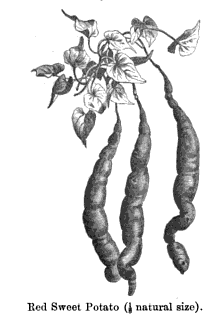
Red Sweet potato

M.L. Tyson’s 1874 cookbook The Queen of the Kitchen: A Collection of Southern Cooking Receipts has been, as the author writes, “carefully compiled from several old family receipt-books, which are regarded as heir-looms; many of them being nearly a century old.”

Tyson prides herself on the variety of recipes in her cookbook. “That the single volume contains many different style of cooking is, in itself, a recommendation,” she writes, “for, as every cook knows, the great art of cooking is to combine variety with simplicity, and that it is chiefly in the manner of preparing food that makes it palatable.”

Tyson’s economical recipe for sweet potato pie exemplifies this adage. This tasty dessert goes well with sweetened heavy cream.

Sweet Potato Pie

Bake sweet potatoes not quite done; peel them, and cut them in slices; put them onto a deep pie-plate, lined with rich paste [pastry]; put a layer of potatoes, and one of brown sugar; on the top layers, put 1 table-spoon of butter, cut in small pieces; pour over it a little wine and water mixed, or a little lemon juice and water; bake slowly for 1 hour. If the oven is hot it will burn with cooking the pie.


Why Fast and Fermented Foods by Christine Baumgarthuber

Would you rather receive The Austerity Kitchen by email? Then sign up for my Substack.

And, if you’d like to help the Kitchen keep cookin’, please consider picking up copies of my books, Why Fast? and Fermented Foods.