Review: A Book of Mediterranean Food

lighthouse on rocky bluff

A Book of Mediterranean Food
By Elizabeth David
New York Review Books Classics, 203 pp., $14.95

In 1939 Elizabeth David, a lord’s granddaughter and a countess’s niece, borrowed against her small inheritance in order to buy a two-masted yacht on which to set sail with her paramour, the already married actor and playwright Charles Gibson-Cowan. Together they headed for the deep blue waters of the Mediterranean, leaving behind her family’s shabby-genteel Sussex manor. From Antibes and Corsica to Italy’s west coast David and her companion literally devoured everything Europe’s lower latitudes had to offer, enjoying, as she would later write in the introduction to her 1950 cookbook A Book of Mediterranean Food, “bright vegetables,” “white ewe’s milk cheese,” hearty dishes of “rice with lamb and currants and pine nuts” and “rose petal jam,” “evening ices eaten on an Athenian cafe terrace in sight of the Parthenon,” and “unlikely fish stews concocted by a sponge diver from the Dodecanese island of Symi.”

Continue reading
A Springtime Potato Salad

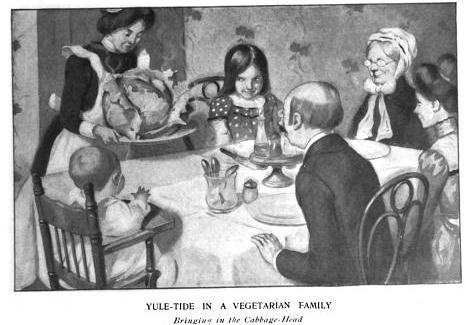
vegetarian family holiday feast

“A salad demands two things: — its vegetable foundation, and its dressing, both of which may be a good deal varied,” writes Arthur Robert Kenney-Herbert in his 1907 cookbook, Vegetarian and Simple Diet. In this guidebook to vegetarian eating, the author sets out to “show that vegetarian diet need not be marked by ascetic plainness, not restricted to a few uninteresting dishes; that pleasant variety is by no means difficult to bring about, and that the possibilities within the reach of the vegetarian cook are really encouraging.” Salads are no exception, and Kenney-Herbert’s chapter on them offers delightful recipes that rest solidly on vegetable foundations (both cooked and raw).

Endives, young radishes, garden-cress, Japanese artichokes, sea kale, haricot beans and the humble cabbage all make an appearance in Kenney-Herbert’s appetizing vegetal creations. But it is his recipe for an unassuming potato salad that seems most fitting for a meatless springtime luncheon.

Potato Salad (Pommes de terre en salade)

Having steamed the potatoes carefully — they must not be too floury to yield nice slices — cut them in slices and dress as in the foregoing. [Let them get quite cold, put them into the bowl, anoint them with salad oil, and dust them with newly ground black pepper and salt . Lastly, give them a few drops of red wine vinegar and a sprinkling of finely minced tarragon and chives, or green stem of spring onions] With this thin strips of celery may be mixed, and some add a few pieces of beet-root, but I think that this is a mistake, because the juice of the beet-root discolours the salad in an unsightly manner.


Why Fast and Fermented Foods by Christine Baumgarthuber

Would you rather receive The Austerity Kitchen by email? Then sign up for my Substack.

And, if you’d like to help the Kitchen keep cookin’, please consider picking up copies of my books, Why Fast? and Fermented Foods.

Coney Island Clam Chowder

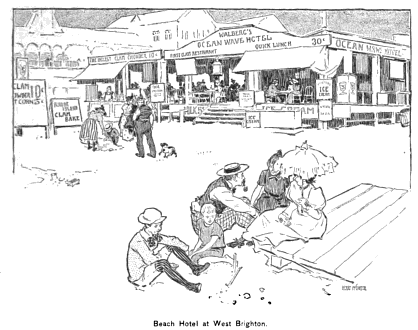
Hotel at Brighton Beach, New York

The estival attractions of Coney Island were such that few late nineteenth-century New Yorkers could resist them. Each weekend crowds of weary shopgirls, clerks, bricklayers and jobbers of every stripe would flock to its white-sand beaches, making their way by train or foot for a weekend seaside idyll, which provided welcome respite from their urban toil.

An article in the July 1896 edition of Scribner’s Magazine reports that the majority of Coney Island pleasure seekers came from the ranks of the middle and lower middle classes, people who enjoyed such meager leisure time that they could ill-afford long schleps upstate. “Evidence that Coney Island’s crowds are made up most largely of those who are town-stayed all summer, lies in the color of the crowd’s hands and faces,” article author Julian Ralph writes. “From the waxen whiteness of the women and girls whose waking hours are spent amid gaslight, to the pinker hue of the men who have leisure to walk to and from luncheon — if not to business — every morning the color of all is the same and only the shades of it differ.”

Continue reading