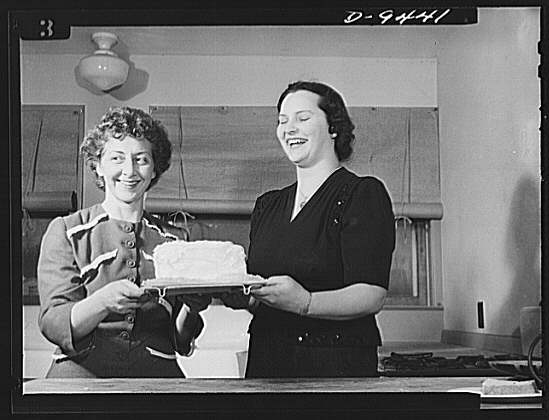
Warm weather heralds the arrival of berry season, and thoughts naturally turn to the various trifles, cakes, parfaits and tarts that make this season all the sweeter. The following recipe for blueberry-honey cake, which appears in Joanne Lamb Hayes’s informative 2003 tome, Grandma’s Wartime Baking Book, makes for a delightful summertime dessert.
Because butter and sugar were rare in wartime America, Hayes’s recipe, which is based on one from the February 1943 issue of Farm Journal and Farmer’s Wife, calls for honey and chicken fat. Though you may not want to exchange now-abundant sugar for honey, using butter in place of chicken fat does make for a tastier cake.
Hayes suggests serving “this cake with colorful lemonade that has been sweetened with the syrup from the jar of fruit.”
Blueberry-Honey Cake
2 3/4 cups unsifted all-purpose flour
3 teaspoons baking powder
1 teaspoon ground cinnamon
1/2 teaspoon baking soda
1/2 teaspoon salt
1/4 teaspoon ground nutmeg
1 cup honey
2/3 cup chicken fat (or butter), softened
2 large eggs
2/3 cup milk
1 cup drained canned blueberries, blackberries, or cherries
Penuche Frosting (recipe follows)
Preheat oven to 375 degrees F. Grease and flour three 9-inch round baking pans. Stir together the flour, baking powder, cinnamon, soda, salt, and nutmeg in a medium bowl.
Beat the honey and chicken fat or butter with an electric mixer on high speed until fluffy; beat in the eggs all at once. Spoon the dry ingredients over the honey mixture; add the milk and beat on low speed, scraping side of bowl occasionally, just until smooth. Fold in the berries.
Divide the batter among the prepared pans and bake 20 to 25 minutes or until the centers spring back when lightly pressed.
Cool layers in pans 5 minutes. Remove to wire racks and cool completely. Fill between layers and frost just the top with frosting.
Penuche Frosting: Combine 2 cups packed light brown sugar, 1/2 cup milk, 1/4 cup shortening or butter, and 2 tablespoons light corn syrup in a heavy saucepan. Bring to a boil and cook to 220 degrees F., stirring constantly, about 1 minutes. Remove from heat. Stir in 1/2 teaspoon vanilla extract and beat until thick and spreadable.
10 servings


 The Austerity Kitchen