From Lorch on the Rhine: Kartoffelgemüs

Ruins of Lorch on the Rhine in Germany

On the right bank of the Rhine, near the entrance to a small valley known as the Whisperthal, sits the ancient town of Lorch.

Legends of Lorch’s haunted ruins and riotous inns attracted travelers in search of adventure. Once, after drinking their fill of the ruby-colored Rhenish wine at one such inn, three young men, the sons of wealthy merchants from Nürnberg, ventured into the ancient forests of the Whisperthal. There, amid fetid swamps and craggy ravines, they met with three beautiful maidens with eyes like diamonds and hair glossy and black. The maidens promised marriage and riches if the travelers would recover their pet birds–a magpie, a starling and a raven–who had recently flown away.

The men searched the forest well into twilight before they found the missing birds. But when they returned to the spot where they had first met the maidens, only three toothless hags stood, cackling like devils. The hags offered rusty goblets of bitter wine to their future bridegrooms; filled with disgust and hopelessness, the young men accepted. Upon drinking the wine, however, they fell senseless to the ground. It was black night before the young men awoke and found themselves surrounded by nothing but the swaying elms and lindens of the Whisperthal, the hags nowhere to be seen.
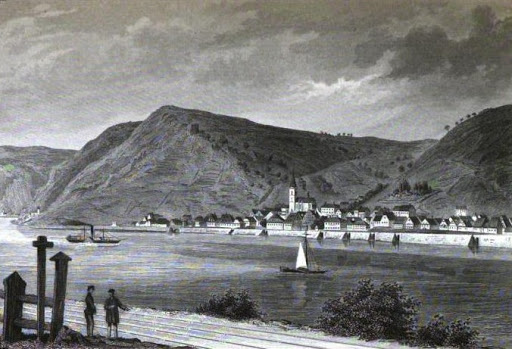
Lorch on the Rhine ca. 1850
Lorch on the Rhine, ca. 1850

The three travelers from Nürnberg swore never to venture into the Whisperthal again. But their tale of magic and love has been told many a time over a jug of Rhenish wine and simple peasant fare in the Rhine Valley’s rowdy inns, where, Charles Dickens complained, “stoutish men, entirely dressed in jewels and dirt, and having nothing else upon them, will remain all night, clinking glasses, and singing about the river that flows and the grape that grows.”

Like many situated north of the Alps, Lorch was a poor town, but its wholesome fare made up for the more unpleasant traits of its inhabitants. Potatoes appeared frequently on the tables of the town’s modest homes. An affordable staple, they were prepared in numberless ways–as stews, gratins, dumplings and cakes. Here is a recipe for Kartoffelgemüs, potatoes cooked in stock, a traditional peasant dish from Hesse, the German state in which Lorch is located.

Kartoffelgemüs

8 potatoes
Salt
2 onions
2 tbsp pork lard
2 cups/500 ml meat stock
1 bay leaf
1 clove
Pinch of sugar
Pepper
1 tbsp mild wine vinegar
1 bunch dill, finely chopped
1/2 bunch parsley, fine chopped

Wash the potatoes and boil them in their skins in salted water until tender but not too soft. Drain the potatoes, rinse with cold water and leave to cool a little, then peel and cut into thin slices. Peel and chop onions. Heat lard in a heavy iron frying pan and cook the onions until transparent. Pour in the meat stock, and add the bay leaf and clove. Stir in the potato slices and season with salt, sugar, pepper and vinegar. Simmer until potatoes have absorbed nearly all the stock. Garnish with chopped herbs just before serving.


Why Fast and Fermented Foods by Christine Baumgarthuber

Would you rather receive The Austerity Kitchen by email? Then sign up for my Substack.

And, if you’d like to help the Kitchen keep cookin’, please consider picking up copies of my books, Why Fast? and Fermented Foods.

Mushrooms: The Poor Man’s Meat

Fly agaric mushroom

Alfred Kreymborg felt the lowly mushroom perfectly exemplified his poetic genius. In his 1916 Mushrooms: A Book of Free Forms he wrote, “Mushrooms spring up overnight in my heart […] myriads and myriads I have found down there, but only a handful have I plucked so far.”

Perhaps Kreymborg should have plucked more of his heart’s lyrical fungi: His book garnered mixed reviews. But its subject continues to fascinate. Coming in all shapes and sizes, mushrooms begin to peek from the loamy soil once the weather turns cool and moist. The tall, proud Panther Cap juts from piles of decaying leaves, and Giant Puffballs swell their waxen bellies under the forest floor. Shaggy Coprinus grows a cap of yellowed scales beneath which peek the frill of purple gills; deadly Amanita glares from hollowed trees.

Prized for their tasty flesh mushrooms were a favorite food among the rural poor, who looked to the forests for a free supply. In the nineteenth century reformers urged English cottagers to start growing mushroom crops systematically to supplement their meager diets. In 1884 John Wright, assistant editor of the Journal of Horticulture and Home Farmer, called the mushroom “the most profitable outdoor crop known.” He urged all cottagers to undertake mushroom farming as “a well-conducted method of growing Mushrooms will pay better” than all other food crops.

In France pallid workers grew mushrooms in caves and abandoned mines. The Seine region alone had almost 3,000 mushroom caves, in which about 300 people worked and lived, rarely seeing the light of day. These subterranean farmers carefully tended beds of seeded manure until their delicate crop peeped forth. Then at exactly one in the morning, when the air was sufficiently clammy and chill, they harvested the mushrooms and, no more than two hours later, rushed them off to the bustling markets of France.

boletus satanas devil's bolete
The Devil’s Bolete

Here is a recipe for fried mushrooms, a dish that was popular among the peasantry throughout Europe. If you can, try to use the ample Steinpilz, otherwise known as the King Bolete–it is an exceptionally tasty variety of mushroom. Look for its tell-tale “hump” under piles of fir needles in coniferous forests.

Serve this dish with pasta or as substitute for meat in a sandwich.

Fried Mushrooms

Peel large, firm mushrooms, taking care not to break them, and cut off the stalks. Roll mushrooms in cracker meal [or breadcrumbs], dip them in beaten egg, then in cracker meal again. Sprinkle with salt and pepper and fry in butter. Garnish with slices of lemon.


Baumgarthuber, Christine. Fermented Foods: The History and Science of a Microbiological Wonder. Reaktion Books, 2021.

Would you rather receive The Austerity Kitchen by email? Then sign up for my Substack.

And, if you’d like to help the Kitchen keep cookin’, please consider picking up a copy of my book, which you may find on one of the sites listed here.

Pease Pudding Hot

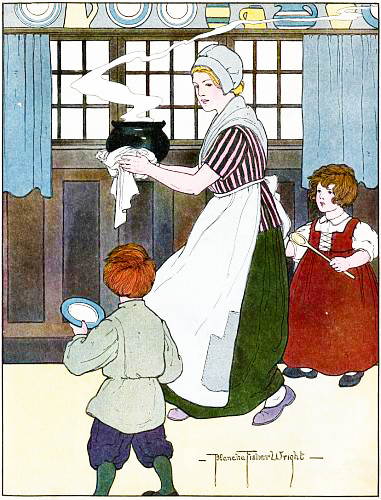
Illustration of woman serving pease porridge

“Pease pudding hot, Pease pudding cold,
Pease pudding in the pot — nine days old.
Some like it hot, some like it cold,
Some like it in the pot, nine days old.”

While the origins of “Pease Pudding Hot” are unknown, the dish described in the rhyme is a thick, smooth paste made from dried peas or lentils. Traditionally served with boiled bacon or a type of sausage called a saveloy, it appeared frequently on the tables of the lower classes, where, more often than was desired, it sat in a pot for nine days (or more), heated and then reheated until finished off.

Was nine-day-old pease pudding palatable, you ask? The July 24, 1884 edition of Knowledge, An Illustrated Magazine of Science reports that aged pease pudding was, in fact, a great treat. It mentions a reader who “has seven dishes of [pease pudding] in his larder, corresponding to the days of the week [and] each being seven days old.” The brave reader claims old pease pudding is easier to digest than new. The editor of Knowledge, however, warns the nursery rhyme offers sage advice: Nine days is the limit pease pudding can be kept in a larder before it’s likely to make the unwary diner ill.

The following recipe for pease pudding comes from Maria Eliza Ketelby Rundell’s The New Family Receipt-Book (1810). Serve pease pudding with boiled pork or, if you are vegetarian, by itself. Do not, however, keep your pease pudding for more than a day or two without refrigeration.

Pease Pudding Hot

Take a pint of yellow split pease, and after tying them loosely in a cloth, boil them in water until they become tender. Then rub them through a cullender [colander] or hair sieve [sieve], and add to the pulp a bit of butter, a spoonful of cream, two eggs, and white pepper and salt. After being uniformly mixed, put the pease into a cloth; tie tightly, and boil for the space of half an hour, to make the ingredients set.


Why Fast and Fermented Foods by Christine Baumgarthuber

Would you rather receive The Austerity Kitchen by email? Then sign up for my Substack.

And, if you’d like to help the Kitchen keep cookin’, please consider picking up copies of my books, Why Fast? and Fermented Foods.