Roast Beef with Yorkshire Pudding

poverty graph in early 20th century new york

Benjamin Seebohm Rowntree investigated the lives of York’s poor and collected his observations in the 1902 work Poverty: A Study of Town Life. “My object in undertaking the investigation detailed in this volume was, if possible, to throw some light upon the conditions which govern the life of the wage-earning classes in provincial town, and especially upon the problem of poverty,” he writes in the introduction.

Rowntree devoted a chapter of his study to the eating habits of the lower classes. He writes that he “obtained exact information regarding the quantity, character, and cost of the food consumed by eighteen families belonging to all sections of the working classes, from the poorest upwards.”

Rowntree’s observations reveal that food like bacon and brown bread appeared frequently on the tables of the poor. Yorkshire pudding seemed an especially popular item among York’s downtrodden. Economical and tasty, it served as a filling side dish to more substantial foodstuffs like roast beef (enjoyed in those rare prosperous times) and cabbage.

Here is a recipe for Yorkshire pudding from the 1902 Mother’s Cook Book that is just as economical and filling as the dinnertime favorite of York’s poor.

Roast Beef with Yorkshire Pudding

Have your meat ready for roasting on Saturday, always. Roast upon a grating of several clean sticks (not pine) laid over the dripping-pan. Dash a cup of boiling water over the beef when it goes into the oven; baste often, and see that the fat does not scorch. About three-quarters of an hour before it is done, mix the pudding.

Yorkshire Pudding

One pint of milk, four eggs, whites and yolks beaten separately; two cups of flour — prepared flour is best; one teaspoonful of salt.

Use less flour if the batter grows too stiff. Mix quickly; pour off the fat from the top of the gravy in the dripping pan, leaving just enough to prevent the pudding from sticking to the bottom. Pour in the batter and continue to roast the beef, letting the dripping fall upon the pudding below. The oven should be brisk by this time. Baste the meat with the gravy you have taken out to make room for the batter. In serving, cut the pudding into squares and lay about the meat in the dish. It is very delicious.


Why Fast and Fermented Foods by Christine Baumgarthuber

Would you rather receive The Austerity Kitchen by email? Then sign up for my Substack.

And, if you’d like to help the Kitchen keep cookin’, please consider picking up copies of my books, Why Fast? and Fermented Foods.
From the Queen of the Kitchen: Sweet Potato Pie

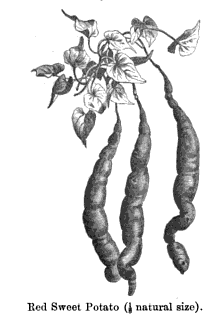
Red Sweet potato

M.L. Tyson’s 1874 cookbook The Queen of the Kitchen: A Collection of Southern Cooking Receipts has been, as the author writes, “carefully compiled from several old family receipt-books, which are regarded as heir-looms; many of them being nearly a century old.”

Tyson prides herself on the variety of recipes in her cookbook. “That the single volume contains many different style of cooking is, in itself, a recommendation,” she writes, “for, as every cook knows, the great art of cooking is to combine variety with simplicity, and that it is chiefly in the manner of preparing food that makes it palatable.”

Tyson’s economical recipe for sweet potato pie exemplifies this adage. This tasty dessert goes well with sweetened heavy cream.

Sweet Potato Pie

Bake sweet potatoes not quite done; peel them, and cut them in slices; put them onto a deep pie-plate, lined with rich paste [pastry]; put a layer of potatoes, and one of brown sugar; on the top layers, put 1 table-spoon of butter, cut in small pieces; pour over it a little wine and water mixed, or a little lemon juice and water; bake slowly for 1 hour. If the oven is hot it will burn with cooking the pie.


Why Fast and Fermented Foods by Christine Baumgarthuber

Would you rather receive The Austerity Kitchen by email? Then sign up for my Substack.

And, if you’d like to help the Kitchen keep cookin’, please consider picking up copies of my books, Why Fast? and Fermented Foods.

Liver Dumpling Soup

immigration to the USA and liver dumpling soup

Bertha M. Wood explores the secrets of health and happiness in her 1922 treatise Foods of the Foreign-Born in Relation to Health. In this unique work, Wood, an American dietitian who studied immigrant cuisine, looks at the foods enjoyed by Mexican, Portuguese, Italian, Hungarian, Turkish, Jewish and Syrian immigrant families in an attempt to discern the foods responsible for these people’s good health.

Wood devotes a large section of the book dissecting the diets of “Poles and other Slavic peoples.” “The Polish children and those of the other Slavic peoples come from a sturdy race,” she writes, “Upon arrival in this country they have round, well-shaped heads, rosy cheek, and strong bodies. With their kerchiefs over their heads they make fascinating pictures of health.”

Wood presents Polish liver dumpling soup as one of the more nutritious dishes enjoyed by Slavic families in the United States. Here’s a recipe — apt perhaps to make for rosy cheeks — from the 1922 cookbook The Art of German Cooking and Baking.

Liver-Dumpling Soup

(Quantity for 6 Persons)

1/4 lb. of chopped calf’s liver
1 tsp. butter
A little grated onion
1 tsp. finely chopped parsley
5 tbsps grated rolls
2 eggs
1 tsp. salt, (scant)
1 pinch nutmeg

Preparation: The butter is stirred and liver, yolk of eggs, salt, parsley, onion, nutmeg and roll crumbs added. The whites of eggs are beaten to a froth and stirred into the mass, then small dumplings are formed. When the bouillon comes to a boil, put dumplings in and boil 1/4 hour. The soup should be served at once.


Why Fast and Fermented Foods by Christine Baumgarthuber

Would you rather receive The Austerity Kitchen by email? Then sign up for my Substack.

And, if you’d like to help the Kitchen keep cookin’, please consider picking up copies of my books, Why Fast? and Fermented Foods.