Shad: The Colonist’s Curse

With its small olive eyes stamped above a slight snubbed nose, a mouth fixed in a downward smile and a puffed opalescent belly, the shad is an unassuming fish.

But it’s also a tasty fish. Nineteenth-century epicures prized the shad’s fatty tender flesh and delicate flavor. During shad season (February to June) American fishermen thronged to rivers with scoop nets and seines, hoping to bring home their share of the popular fish. In Brooklyn great heaps of freshly-caught shad could be found piled on doorsteps, waiting for the unlucky housewife to do the malodorous business of cleaning and deboning before salting and storing the fish away.
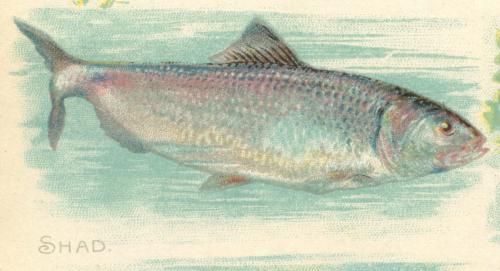
Shad a food fish of Norht America
Shad, a popular food fish among North American colonists


Just a century before, however, shad was considered a positive nuisance. Farm laborers living near the Connecticut River insisted shad be served but once a week for dinner. Anything more was considered cruel and unusual treatment. Entire families felt dining on shad a shameful act: One night, while feasting on a dish of broiled shad cheaply bought, a family in Hadley, Massachusetts suddenly heard a knock at the front door. Terrified lest someone witness the ignoble and unfashionable dinner, they quickly hid the plate of half-eaten shad in a cupboard before inviting the unexpected guest in.

Shad then was fed to the hogs and the poor. In 1733, an impoverished housewife could purchase two shad for a penny — a price almost embarrassingly cheap. The fish was usually eaten baked, boiled or broiled, but never fried as it contains too much oil. Should you not feel an undue amount of shame at the prospect of preparing such a fish, try this 1856 recipe for broiled shad, which can be served with a slice of lemon and boiled potatoes.

Broiled Shad

Scale, wash and score the shad, then mix together one tablespoon of salt, and one of sugar; rub this over the fish, and let it remain for two hours; then wash it again, dry it on a towel, and season with cayenne pepper and salt. Heat the gridiron [or frying pan] and butter the bars; broil it [the fish] gradually; when one side is well browned, turn it. When done, place it on a dish; baste with butter and send to table hot.


Why Fast and Fermented Foods by Christine Baumgarthuber

Would you rather receive The Austerity Kitchen by email? Then sign up for my Substack.

And, if you’d like to help the Kitchen keep cookin’, please consider picking up copies of my books, Why Fast? and Fermented Foods.

From the Cantabrian Mountains: Pollo Campurriano

Spain’s Cantabrian Mountains stretch from the western limits of the towering Pyrenees to the borders of Galicia. They follow the sea as far as the pass of Leitariegos and afterward break off, trending southward toward Leon.

Savage and ruthless, the ancient tribe of Cantabri once found refuge among the Cantabrian’s magnificent peaks. There they defied the Romans, who wished to subdue the region and its wild mountaineers. Not until the bloody campaigns of Agrippa and Augustus (29-19 CE) did the Cantabri suffer defeat and become partially Romanized, their fierce history made the stuff of fireside tales.

Cantabrian Mountains of Spain recipe for Pollo Campurriano
Carlos de Haes, Los Picos de Europa, 1860

But despite the defeat of the Cantabri, a tenacious sense of independence burned in the hearts of the people of Cantabria. Described in nineteenth-century guidebooks as “reserved in speech and conversation,” the Cantabrians spoke in a “Mountain language” not recognized outside the region. They were said to be insensible to changes of heat or cold, and defended their homes not by sword or knife, but by an oaken shillalah, a walking stick fortified with lead. Expert oarsmen, they fished the Bay of Biscay’s treacherous waters by day and at night danced to the jangling sound of the tamboril and pito. They bred superb race horses and silkworms.

Cantabrian cuisine was spartan but nourishing. Inside their small cottages, the Cantabrians knew not the pleasures of beer and cooked their food in hog’s lard and olive oil, vast cisterns of which could be found in the kitchens of most homes. Their cheese was prized for its delicacy, and the sea provided them with swordfish, squid and hake. Cantabrians were especially fond of sweets and their cattle gave them the cream necessary for their beloved rice puddings and custards.

Here is a dish from a farming community inland from the city of Santander, the capital of Cantabria. Should you wish for more Spanish recipes, visit spain-recipes.com.

Pollo Campurriano (Santander Chicken)

4 small corn-fed chicken quarters
6 tablespoons olive oil
Salt and freshly ground black pepper
3 teaspoon paprika
2 teaspoon flour
5 oz streaky tocino or raw ham, cubed
1 red pepper, seeded and chopped
1 green pepper, seeded and chopped
8 fat white spring onions or pickling onions
1 bay leaf
16 fl. oz chicken stock
1 spanish onion, chopped
2 garlic cloves, finely chopped
7 fl. oz rice
9 fl. oz dry white wine

Heat 4 tablespoons of oil in a frying pan. Salt and pepper the chicken well, rubbing the flesh with 2 teaspoons of paprika, then dust with flour. Fry skin side down over medium-high heat, for 5 minutes on each side, until golden. When you turn the chicken, add the tocino or chopped ham, peppers and spring onion bulbs.

Move to a casserole in which the chicken will fit tightly in one layer. Pack the chicken in neatly and sprinkle with the remaining flour. Tuck the spring onion bulbs, ham and peppers into any spaces with the bay leafs. Add just enough stock to cover the ingredients — about 6-8 fl. oz. Put on the lid and simmer gently.

Add the onion to the oil remaining in the frying pan and fry until softened, adding a little more oil if needed. Add the chopped garlic cloves and the rice. Sprinkle with 1 teaspoon of paprika and stir gently. Pour in the wine and bring gently to the boil. Add 10 fl. oz of stock and cook gently for 15 minutes. The stock should just be absorbed. Small quantities of rice can dry out so watch for this and add another couple of spoonfuls of liquid from the chicken pot if necessary.

When the rice is done, cover with foil and leave to stand off the heat for 5 minutes. Turn off the chicken too. Serve the two dishes together. You can sprinkle a little chopped green onion top over the chicken to garnish.


Why Fast and Fermented Foods by Christine Baumgarthuber

Would you rather receive The Austerity Kitchen by email? Then sign up for my Substack.

And, if you’d like to help the Kitchen keep cookin’, please consider picking up copies of my books, Why Fast? and Fermented Foods.

Mushrooms: The Poor Man’s Meat

Fly agaric mushroom

Alfred Kreymborg felt the lowly mushroom perfectly exemplified his poetic genius. In his 1916 Mushrooms: A Book of Free Forms he wrote, “Mushrooms spring up overnight in my heart […] myriads and myriads I have found down there, but only a handful have I plucked so far.”

Perhaps Kreymborg should have plucked more of his heart’s lyrical fungi: His book garnered mixed reviews. But its subject continues to fascinate. Coming in all shapes and sizes, mushrooms begin to peek from the loamy soil once the weather turns cool and moist. The tall, proud Panther Cap juts from piles of decaying leaves, and Giant Puffballs swell their waxen bellies under the forest floor. Shaggy Coprinus grows a cap of yellowed scales beneath which peek the frill of purple gills; deadly Amanita glares from hollowed trees.

Prized for their tasty flesh mushrooms were a favorite food among the rural poor, who looked to the forests for a free supply. In the nineteenth century reformers urged English cottagers to start growing mushroom crops systematically to supplement their meager diets. In 1884 John Wright, assistant editor of the Journal of Horticulture and Home Farmer, called the mushroom “the most profitable outdoor crop known.” He urged all cottagers to undertake mushroom farming as “a well-conducted method of growing Mushrooms will pay better” than all other food crops.

In France pallid workers grew mushrooms in caves and abandoned mines. The Seine region alone had almost 3,000 mushroom caves, in which about 300 people worked and lived, rarely seeing the light of day. These subterranean farmers carefully tended beds of seeded manure until their delicate crop peeped forth. Then at exactly one in the morning, when the air was sufficiently clammy and chill, they harvested the mushrooms and, no more than two hours later, rushed them off to the bustling markets of France.

boletus satanas devil's bolete
The Devil’s Bolete

Here is a recipe for fried mushrooms, a dish that was popular among the peasantry throughout Europe. If you can, try to use the ample Steinpilz, otherwise known as the King Bolete–it is an exceptionally tasty variety of mushroom. Look for its tell-tale “hump” under piles of fir needles in coniferous forests.

Serve this dish with pasta or as substitute for meat in a sandwich.

Fried Mushrooms

Peel large, firm mushrooms, taking care not to break them, and cut off the stalks. Roll mushrooms in cracker meal [or breadcrumbs], dip them in beaten egg, then in cracker meal again. Sprinkle with salt and pepper and fry in butter. Garnish with slices of lemon.


Baumgarthuber, Christine. Fermented Foods: The History and Science of a Microbiological Wonder. Reaktion Books, 2021.

Would you rather receive The Austerity Kitchen by email? Then sign up for my Substack.

And, if you’d like to help the Kitchen keep cookin’, please consider picking up a copy of my book, which you may find on one of the sites listed here.