Braised Beef Heart

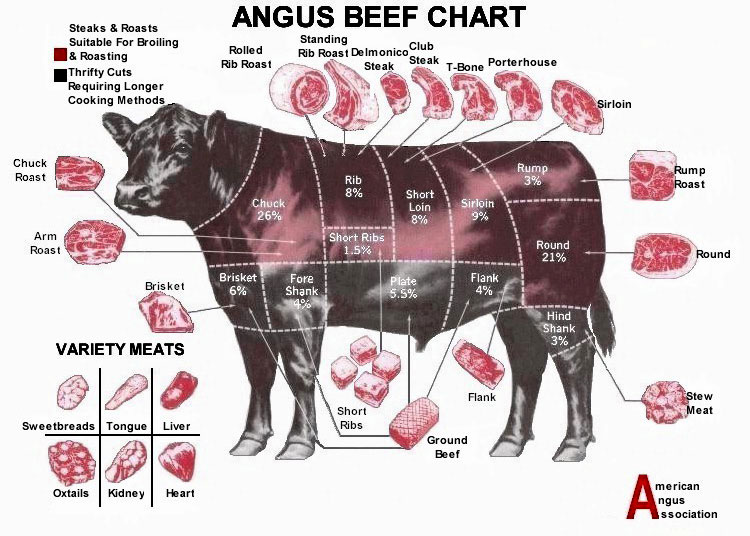
angus beef chart for butchers

“Most housekeepers get into a ‘rut’ and buy the same steaks, chops and roast each week, having no repertoire of cheaper dishes,” an 1888 edition of Table Talk laments. The author suggests that “a beef’s heart or a braised calf’s liver make an excellent and economical change.” Certainly beef heart is one of the more neglected pieces of meat. And this is indeed a sad fact. For beef heart, if properly cooked, is quite delicious — and exceptionally nutritious.

Here’s an economical and tasty recipe for braised beef heart from food.com. Serve this dish with a green salad and a crusty loaf of sourdough bread.

Braised Beef Heart

3 lbs beef heart
3 tablespoons onion soup mix
1 cup water
2 tablespoons vegetable oil
1 medium onion
1 teaspoon prepared mustard
1 cube beef bouillon
1/2 cup breadcrumbs

1. Trim any fat off the heart. Use a pair of kitchen scissors to cut off any large pieces of the connective tissue around the top of the meat.

2. Roll into a roast form and tie with string.

3 Brown in the oil on all sides.

4. Put in a dutch oven and add the onion, cut into about 8 pieces, and all the other ingredients, except the bread crumbs.

5. Bring to a boil, reduce heat and simmer for 4 hours, turning every hour.

6. After 2 hours, add the bread crumbs.

7. When done, remove heart and use an immersion blender or regular blender to smooth the gravy. If desired, you can thicken the gravy some more with a water and flour mixture, bringing it to the boil.

8. Slice the heart lengthwise into 1/4″ slices.


Why Fast and Fermented Foods by Christine Baumgarthuber

Would you rather receive The Austerity Kitchen by email? Then sign up for my Substack.

And, if you’d like to help the Kitchen keep cookin’, please consider picking up copies of my books, Why Fast? and Fermented Foods.


Crawfish Bisque

crawfish, otherwise known as crawdad and crayfish

The crawfish (also known as a crayfish or crawdad, depending on the region) is a freshwater crustacean resembling a lobster. Frequently found in brooks and steams, the crawfish prefers to live in only the cleanest water. The greatest number and diversity of crawfish are found in south-eastern North America, where they are caught and prepared in a number of appetizing and economical ways.

But only a small portion of the crawfish is edible–usually the tail. Crawfish therefore feature frequently in soups, stews and bisques. Sometimes the claws of larger specimens can be cracked open and meat extracted; because of the larger amount of flesh they provide, these larger specimens feature frequently in dishes like low country boils, where the advice is to “suck the head; pinch the tail.”

Here is a recipe from an 1887 edition of Good Housekeeping for crawfish bisque. Use your food processor instead of the suggested mortar to save time. Serve the bisque with a crusty French bread and a green salad.

Crawfish Bisque

Take fifty crawfish, wash them in several waters, and put them in a saucepan over a brisk fire. Add to them salt, whole black pepper, and butter the size of an egg, with a little grated nutmeg. Stir with a spoon for one-half hour. When cooked, drain the crawfish, free them from the shells, and mash the meat in a mortar. Boil one cup of rice in the crawfish bouillon for a quarter of an hour, drain it and put it in the mortar with the crawfish, pounding it well. Put all back into the saucepan, thin it with the bouillon and pass it through a sieve. Mash the crawfish shells, add bouillon in which they were cooked, and strain it through a sieve into the crawfish and rice puree. It then should be of a reddish color. Put this into a saucepan over a moderate fire, not letting it boil, but it must be very hot. Put some toasted bread in the tureen, add to the broth one wineglassful of Madeira wine, and pour over toast. Serve immediately.


Why Fast and Fermented Foods by Christine Baumgarthuber

Would you rather receive The Austerity Kitchen by email? Then sign up for my Substack.

And, if you’d like to help the Kitchen keep cookin’, please consider picking up copies of my books, Why Fast? and Fermented Foods.

A Viennese Favorite: Tafelspitz

Franz Joseph I, Emperor of Austria

Franz Joseph I, Emperor of Austria, was a notoriously fast eater. This proved troublesome to the court as every time he entertained his highest military officials, Franz Joseph was the first to be served. The rules of etiquette at the time dictated that once the Emperor stopped eating, everyone at the table must also finish their meals. Because of the rapidity with which he finished his meals, the soldiers were never able to finish their meals, leaving the table as hungry as when they first arrived.

Taking pity on the hungry soldiers, the court chefs created a simple but delicious dish that could be quickly prepared and brought to table: Tafelspitz, or Viennese boiled beef. Franz Joseph was so enamored of the new recipe of boiled beef and vegetables that he insisted upon having it at almost every meal.

Below is a recipe for Tafelspitz from aboutvienna.org. Use a well-aged tri tip, or a piece from the bottom sirloin primal cut, but almost any large cut of beef will suffice for making this recipe. Serve the finished dish with roasted sliced potatoes or a mix of apples, cream and horseradish. Because the process of boiling the beef results in a delicious stock, Tafelspitz is an economical dish — the stock can be saved and used for vegetable soups or stews.

Tafelspitz

2 qts. water
2 large carrots, cut into thin sticks
1 teaspoon salt
4 celery stalks, cut into thin strips (or substitute one celery root for a more authentic flavor)
3 pound beef brisket
2 leeks, white part only
2 gherkins
1 onion – cut into rings parsley

Heat 2 qt. water with salt. Add beef; bring to a boil. Skim foam from surface until clear. Partially cover pot; simmer 1-1/2 hours.

Cut leeks in 2 inch pieces, then cut in half lengthwise. Add leeks, onion, carrots and celery to beef. Cook until beef and vegetables are tender.

Cut beef into 1/2 inch slices. Cut gherkins lengthwise in thin slices, leaving 1 end uncut. Spread out slices like a fan – garnish beef with gherkins.

Serve vegetables in a separate dish with 4 tablespoons cooking liquid spooned over the top. Garnish with parsley.


Why Fast and Fermented Foods by Christine Baumgarthuber

Would you rather receive The Austerity Kitchen by email? Then sign up for my Substack.

And, if you’d like to help the Kitchen keep cookin’, please consider picking up copies of my books, Why Fast? and Fermented Foods.