A Truss of Greens

illustration from Little Dorrit by Charles Dickens

In his 1857 novel Little Dorrit Charles Dickens describes the foodstuffs purveyed by a small restaurant as seen through its dirty windows:

They walked on with him until they came to a dirty shop-window in a dirty street, which was made almost opaque by the steam of hot meats, vegetables, and puddings. But glimpses were to be caught of a roast leg of pork, bursting into tears of sage and onion in a metal reservoir full of gravy, of an unctuous piece of roast beef and blisterous Yorkshire pudding bubbling hot in a similar receptacle, of a stuffed fillet of veal in rapid cut, of a ham in a perspiration with the pace it was going at, of a shallow tank of baked potatoes glued together by their own richness, of a truss or two of boiled greens, and other substantial delicacies.

Though such delights as glimpsed through a dirty shop-window might not tempt more delicate appetites, a “truss or two of boiled greens” can be a nice addition to dinner. The 1865 cookbook Mrs. Goodfellow’s Cookery as It Should Be presents a tasty recipe for boiled greens. Its author writes, “Vegetables are a most useful accessory to our daily food, and should be made the object of greater study in their preparation than they usually receive.” Here’s to this useful accessory finally getting its due.

Boiled Greens

Much depends upon boiling greens, and the manner in which it is done. The water should be soft, and a handful of salt thrown into the water, which should boil before the greens are put in; when, in, the water should then be made to what by cooks is termed “gallop,” the saucepan kept uncovered, and when the greens sink, they are done, take them out quickly and dress for table.


Why Fast and Fermented Foods by Christine Baumgarthuber

Would you rather receive The Austerity Kitchen by email? Then sign up for my Substack.

And, if you’d like to help the Kitchen keep cookin’, please consider picking up copies of my books, Why Fast? and Fermented Foods.

Swedish Codfish

poultry and game


“We fly to Jemteland, where the rocky mountains are high and blue; where the Foss roars and rushes; where the torches are lighted as budstikke, to announce that the ferryman is expected. Up to the deep, cold, running waters, where the midsummer sun does not set; where the rosy hue of eve is that of morn.”

“That is the birds’ song,” writes Hans Christian Andersen in his 1871 travel memoir Pictures of Travel in Sweden, “Shall we lay it to heart? Shall we accompany them — at least a part of the way?” He did follow those birds, and his travels led him through the “glorious land” of Sweden, “home of the limpid elves, where the wild swans sing in the gleam of the Northern Lights.”

Andersen’s meanderings through the land of endless forests eventually brought him to Kinnakulla, Sweden’s hanging gardens. “The travellers go from the forest road up to the top of Kinnakulla,” he writes, “where a stone is raised as the goal of their wanderings.” From this vantage point, where black clouds of crows and ravens scream across a pale blue sky, Anderson writes that he can survey “Wener, to Lockö’s old palace, to the town of Lindkjöping.”

Perhaps Andersen visited an inn in the town of Lindkjöping–unfortunately he does not say if he did or not–and enjoyed a humble meal of stewed codfish, like this one from the 1897 Fullständigaste Svensk-Ameritansk kokbok: Swedish-English Cookbook.

Stewed Codfish

Pound the fish and soak 36 hours; take up, remove the bones and pick it to pieces, boil until tender. Melt in a pan a piece of butter together with a handful flour and add milk enough to make a somewhat thick sauce. Boil it and put the fish into it. Potatoes or cut carrots might be added. Season with pepper and salt.


Baumgarthuber, Christine. Fermented Foods: The History and Science of a Microbiological Wonder. Reaktion Books, 2021.

Would you rather receive The Austerity Kitchen by email? Then sign up for my Substack.

And, if you’d like to help the Kitchen keep cookin’, please consider picking up a copy of my book, which you may find on one of the sites listed here.

A Fried Fish Shop in London

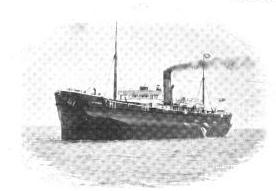
ocean steamer

“At last, after so many years, I am about to realize the dream of my life–a visit to lands beyond the sea,” James Hale Bates, the American originator of the mercantile registry business, wrote on May 1, 1889. He recorded his adventures on the high seas in Notes of Foreign Travels, which he published privately in 1891. “This cool, bright morning, at half-past six, finds me with wife, daughter Betty and niece Mary on board the huge steamer ‘City of New York,'” it begins, “which at the above hour slowly swings from her mooring into the Hudson at Pier 43, and carefully feels her way down the river and harbor, through the Narrows, into the broad Atlantic.”

Continue reading