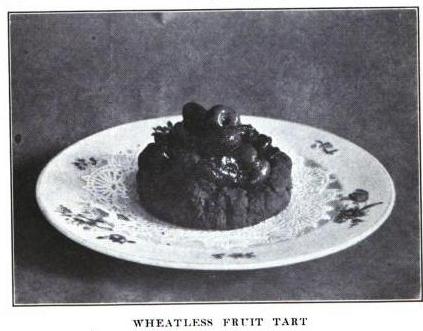
More Wartime Cooking: Wheatless Fruit Tarts

wheatless fruit tart – wartime cooking

Mary Elizabeth was convinced she could develop an entire repertoire of wartime wheatless and sugarless recipes. Her 1918 Mary Elizabeth’s War Time Recipes testifies to the success of her endeavor — the cookbook is filled with dozens of delightful recipes that eschew wheat, sugar and meat. “I am gathering these recipes,” she writes, “that they may help some folks who have the same earnest desire as myself to aid the Food Administration in every way but lack the facilities and time to work out their own recipes.”

Here’s a summer recipe from Mary Elizabeth’s cookbook for a wheatless fruit tart. It uses barley flour as a substitute for wheat, which results in a wonderfully flaky crust. Containing all eight amino acids, barley flour also packs a powerful nutritional punch.

Wheatless Fruit Tarts

1 1/2 cups barley flour
1/2 cup corn flour
1 teaspoon salt
1/2 cup hard vegetable shortening
4 tablespoons ice-cold water

Sift the two flours and salt together; cut into it the shortening, using a knife, until it is in tiny bits. Then rub together lightly with the hands until all the ingredients are well blended. Now add the water, mixing as little as possible.

Mold into a ball. Place on a well-floured bread-board. Roll thin, using a little flour on the rolling pin. Cut with a large biscuit-cutter and place over bottoms of muffin tins. Bake in a hot oven until light brown. When cold, fill the shells with fruit filling.

Fruit Filling for Tarts

Use rhubarb, strawberries, cherries, raspberries or currants. Canned fruit may be used in winter, but as they are sweetened, reduce the sugar quantity by one half.

1 quart fruit (any of the above varieties)
1 cup maple sugar (crushed)
1/4 cup water
3 level tablespoons corn starch

Boil until the fruit is tender. Then add three level tablespoons of cornstarch, dissolved in a tablespoon of water. Boil slowly, stirring constantly, for able five minutes longer. When cold, fill the tart molds and serve.


Why Fast and Fermented Foods by Christine Baumgarthuber

Would you rather receive The Austerity Kitchen by email? Then sign up for my Substack.

And, if you’d like to help the Kitchen keep cookin’, please consider picking up copies of my books, Why Fast? and Fermented Foods.
From Hermann, Missouri: Depression Caramels

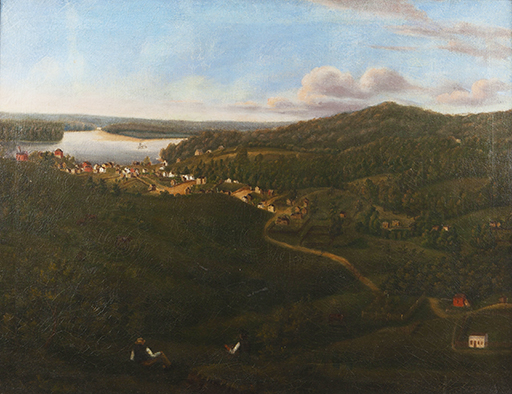
In the early 1830s, the German Settlement Society of Philadelphia traveled to the lush and rugged Gasconade River Valley. There they founded the colony of Hermann, Missouri; the Society thought the Gasconade Valley, with its green rolling hills, resembled their beloved valley of the Rhine River, and they wanted to establish a German community devoted to farming and commerce in the heart of it.

The colony quickly grew into a town of successful vintners. The rocky hills of the Gasconade Valley, while inimical to farming, proved perfect for cultivating grapes, and large vineyards were planted along the hillsides.

Business was brisk in Hermann until Prohibition, when the vineyards were forced to close. So devastating did Prohibition prove to the town that residents said the Great Depression ravaged Hermann ten years before it hit the rest of the country.

Landscape painting of Hermann Missouri circa 1850
Vista on Hermann, Missouri ca. 1850 via Wikimedia Commons

The following recipe for caramels comes from an old Hermann farming family. Dated 1938, it was found handwritten in a cookbook. Made from readily available ingredients, the caramels were a simple delight during the dark days of the Depression.

Hermann Caramels

2 cups sugar
1 can (1 cup) corn syrup
1 can (1 cup) milk
Pinch of salt
1/2 cup butter
1 tsp vanilla
Nuts, if desired

Put sugar, syrup, butter and salt in a saucepan. Cook into a clear, thick consistency. Add milk gradually so as to not stop the boiling. Cook until a firm ball forms. Add vanilla and nuts. Place in a buttered pan until cool. Put on a marble slab or oiled paper [wax paper] and cut into 1-inch squares. Wrap in oiled paper.


Why Fast and Fermented Foods by Christine Baumgarthuber

Would you rather receive The Austerity Kitchen by email? Then sign up for my Substack.

And, if you’d like to help the Kitchen keep cookin’, please consider picking up copies of my books, Why Fast? and Fermented Foods.

Depression Hermits

The lowly hermit has all but been forgotten these days.

A favorite during the Great Depression, the hermit is a square, soft cookie filled with nuts and raisins. It’s origins are a mystery — some say the recipe came from Moravians who settled in Pennsylvania during the nineteenth century. Others theorize that the hermit’s history is rooted firmly in New England. Either way, one can attribute the cookie’s popularity to its ease of preparation and long shelf life.

Cookies known as hermits popular in the American Northeast
Hermits from Monastic Greetings

There are hundreds of hermit recipes out there. Here’s a hermit recipe based on the original recipe from Miss Fanny Farmer’s cookbook, published in 1896. It was supposedly the first hermit recipe to appear in print.

Hermits

1/3 cup butter
2/3 cup sugar
1 egg, well beaten
2 Tbs milk
2 cups flour
2 teaspoons baking powder
1/3 cup raisins, cut into small pieces
1/4 cup nut meats
1/2 teaspoon cinnamon
1/4 teaspoon clove
1/4 teaspoon mace
1/4 teaspoon nutmeg

Cream the butter, then add sugar gradually. Once the sugar and butter are creamed together, add the raisins, nutmeats, egg, and milk. Mix dry ingredients and add to creamed mixture. Dough should be firm, but pliable. Roll dough into long strips lengthwise on a greased cookie sheet. Bake at 350° for about 8-10 minutes, until lightly browned. Cut each strip into 2-inch bars while still warm.

The hermit’s spicy nature ensures that it will last for weeks in a tightly closed tin.


Baumgarthuber, Christine. Fermented Foods: The History and Science of a Microbiological Wonder. Reaktion Books, 2021.

Would you rather receive The Austerity Kitchen by email? Then sign up for my Substack.

And, if you’d like to help the Kitchen keep cookin’, please consider picking up a copy of my book, which you may find on one of the sites listed here.


Why Fast and Fermented Foods by Christine Baumgarthuber

Would you rather receive The Austerity Kitchen by email? Then sign up for my Substack.

And, if you’d like to help the Kitchen keep cookin’, please consider picking up copies of my books, Why Fast? and Fermented Foods.