Wartime Blueberry-Honey Cake

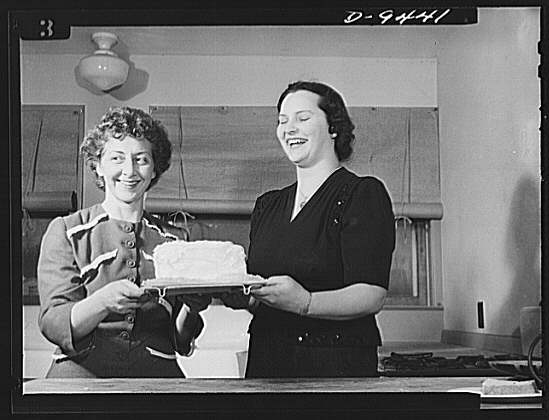
women presenting a wartime cake

Warm weather heralds the arrival of berry season, and thoughts naturally turn to the various trifles, cakes, parfaits and tarts that make this season all the sweeter. The following recipe for blueberry-honey cake, which appears in  Joanne Lamb Hayes’s informative 2003 tome, Grandma’s Wartime Baking Book, makes for a delightful summertime dessert.

Because butter and sugar were rare in wartime America, Hayes’s recipe, which is based on one from the February 1943 issue of Farm Journal and Farmer’s Wife, calls for honey and chicken fat. Though you may not want to exchange now-abundant sugar for honey, using butter in place of chicken fat does make for a tastier cake.

Hayes suggests serving “this cake with colorful lemonade that has been sweetened with the syrup from the jar of fruit.”

Blueberry-Honey Cake

2 3/4 cups unsifted all-purpose flour
3 teaspoons baking powder
1 teaspoon ground cinnamon
1/2 teaspoon baking soda
1/2 teaspoon salt
1/4 teaspoon ground nutmeg
1 cup honey
2/3 cup chicken fat (or butter), softened
2 large eggs
2/3 cup milk
1 cup drained canned blueberries, blackberries, or cherries
Penuche Frosting (recipe follows)

Preheat oven to 375 degrees F. Grease and flour three 9-inch round baking pans.  Stir together the flour, baking powder, cinnamon, soda, salt, and nutmeg in a medium bowl.

Beat the honey and chicken fat or butter with an electric mixer on high speed until fluffy; beat in the eggs all at once. Spoon the dry ingredients over the honey mixture; add the milk and beat on low speed, scraping side of bowl occasionally, just until smooth. Fold in the berries.

Divide the batter among the prepared pans and bake 20 to 25 minutes or until the centers spring back when lightly pressed.

Cool layers in pans 5 minutes. Remove to wire racks and cool completely. Fill between layers and frost just the top with frosting.

Penuche Frosting: Combine 2 cups packed light brown sugar, 1/2 cup milk, 1/4 cup shortening or butter, and 2 tablespoons light corn syrup in a heavy saucepan. Bring to a boil and cook to 220 degrees F., stirring constantly, about 1 minutes. Remove from heat. Stir in 1/2 teaspoon vanilla extract and beat until thick and spreadable.

10 servings


Why Fast and Fermented Foods by Christine Baumgarthuber

Would you rather receive The Austerity Kitchen by email? Then sign up for my Substack.

And, if you’d like to help the Kitchen keep cookin’, please consider picking up copies of my books, Why Fast? and Fermented Foods.

India Cake

vintage ad for Burnett's almond extract

A 1916 advertisement for Burnett’s Almond Extract features a delightful, and economical, recipe for India Cake. Why economical? Because Burnett’s claims its economy comes from “its purity and strength,” which are effects of the fact that “one 2 oz. bottle of Burnett’s Almond gives more flavor than 5 ordinary 10c bottles of inferior or imitation extracts.”

The Joseph Burnett Company was incorporated in 1895 and quickly came to dominate the market in high-quality extracts. The company’s manufacturing headquarters was located in South Boston, and the beautifully restored factory that churned out extracts for worldwide distribution can still be seen today.

Though Joseph Burnett’s superior almond extract did not survive much beyond the mid-twentieth century, you can still make his famous cake by following the recipe below. Just make sure to use an almond extract just as pure and strong!

India Cake

Cream 3/4 cup butter and 2 cups sugar. Add 3 eggs, whites and yolks beaten separately and then together. Add 2 cups flour, 1 teaspoonful soda and 2 of cream of tartar. Add 1 cup milk and 1 scant teaspoonful of Burnett’s Almond. Bake in a slow oven, and frost.


Why Fast and Fermented Foods by Christine Baumgarthuber

Would you rather receive The Austerity Kitchen by email? Then sign up for my Substack.

And, if you’d like to help the Kitchen keep cookin’, please consider picking up copies of my books, Why Fast? and Fermented Foods.

Economical Old-Fashioned Loaf Cake

loaf cakes, illustration

In an article that appeared in an 1871 edition of Southern Farm and Home, Mrs. A.T. Conyers of Georgia gives housewives newly come down in the world tips and tricks for dealing with the trials and tribulations of poverty. She encourages these beleaguered women to take over the work of the household in order to save on servants’ wages. “By doing her work she would feel an interest in saving,” she writes, “and would prevent that useless waste that so often occurs with servants.”


Mrs. Conyers adamantly opposes waste of all kinds. “However wealthy she [the housewife] may be, the poor are too numerous, food for them too scarce to scarce to suffer anything to be wasted. This is frequently done by carelessly allowing cold dishes to accumulate until they are ruined by mould. This is altogether unnecessary, as many dishes can be redressed to advantage.” She then offers the following advice:

Cold meat, for instance, by sprinkling a little salt over it, warming gradually, and serving with gravy, can be made almost as palatable as when fresh cooked. Any kind of bread by keeping it in a tight place from the air, when wanted, placing it in a cold oven or stove, and heating it slowly, will be as good and far healthier than new. Cold bread can also be used in making puddings, etc.

This recipe for old-fashioned loaf cake from the 1883 Dixie Cook-Book, which one reviewer claimed as “the very best and most economical of all cook books,” would likely please Mrs. A.T. Conyers. (Just make sure to do justice to the leftovers.)

Old-Fashioned Loaf Cake

Three pounds (three quarts sifted and well heaped) flour, one and a fourth pounds (a rounded pint of soft) butter, one and three-fourths pounds (one quart) sugar, five gills new milk, half pint yeast, three eggs, two pounds raisins, tea-spoon soda, gill of brandy or wine, or a fourth pint of molasses, two tea-spoons cinnamon and two of nutmeg, scald the milk, cool to blood warm, add the yeast, then the flour, to which all the butter and half the sugar have been added; then mix together, and let rise until light. It is better to set this sponge over night, and in the morning add the other ingredients (flouring raisins), and let rise again. When light, fill baking pans and let rise again. Bake in a moderate oven. This recipe makes three large loaves, and is a standard, economical loaf-cake.


Why Fast and Fermented Foods by Christine Baumgarthuber

Would you rather receive The Austerity Kitchen by email? Then sign up for my Substack.

And, if you’d like to help the Kitchen keep cookin’, please consider picking up copies of my books, Why Fast? and Fermented Foods.