
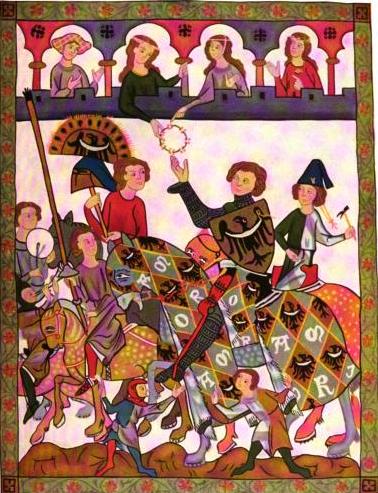
The small Bavarian town of Abensberg sits on the banks of the Abens river, a tributary of the Danube. Flanked by thirty-two round and square turrets, the town was formerly the residence of the counts of Abensberg, whose castle still overshadows the town’s turreted walls.
This castle was the site of a peculiar scene. When Heinrich II, the fifth and last Holy Roman Emperor of the Ottonian dynasty, made his journey through Germany after his coronation in 1002, courtiers lavished him with offerings of gold and other treasures in order to demonstrate their fealty. When Heinrich stopped in Abensberg, he was presented with a gift of a different nature. For the Count of Abensberg brought forward thirty-two of his thirty-seven children and offered them body and soul to the new monarch. The count avowed that they were “the most valuable offering he could make to his king and country.”
How the count — or Heinrich, for that matter — managed to feed this brood of Bavarian princelings is left to historical imagination, but it is easy to picture a long table groaning with dishes of wild game prepared in a manner similar to this dish from Sabina Welserin, a sixteenth-century compiler one of the oldest German cookbooks.
Wild Game Marinated in Peppersauce
Boil fresh game in two parts water and one part wine, and when it is done, then cut it into pieces and lay it in a peppersauce. Let it simmer a while therein. Make [the sauce] so: Take rye bread, cut off the hard crust and cut the bread into pieces, as thick as a finger and as long as the loaf of bread is. Brown it over the fire, until it begins to blacken on both sides. Put it right away into cold water. Do not allow it to remain long therein. After that put it into a kettle, pour into it the broth in which the game was boiled, strain it through a cloth, finely chop onions and bacon, let it cook together, do not put too little in the peppersauce, season it well, let it simmer and put vinegar into it, then you have a good peppersauce.

Would you rather receive The Austerity Kitchen by email? Then sign up for my Substack.
And, if you’d like to help the Kitchen keep cookin’, please consider picking up copies of my books, Why Fast? and Fermented Foods.


 The Austerity Kitchen